
Ch.10 - Gases
Brown - Chemistry: The Central Science 14th Edition
Brown14th EditionChemistry: The Central ScienceISBN: 9780134414232Non è quello che usi tu?Cambia libro di testo
Capitolo 10, Problema 40c

An aerosol spray can with a volume of 125 mL contains 1.30 g of propane gas (C3H8) as a propellant. (c) The can's label says that exposure to temperatures above 50 °C may cause the can to burst. What is the pressure in the can at this temperature?

Guida verificata passo dopo passo
1
Convert the volume of the can from milliliters to liters by dividing by 1000, since 1 L = 1000 mL.
Use the molar mass of propane (C_3H_8) to convert the mass of propane from grams to moles. The molar mass of C_3H_8 is approximately 44.10 g/mol.
Apply the Ideal Gas Law, PV = nRT, where P is pressure, V is volume, n is the number of moles, R is the ideal gas constant (0.0821 L·atm/mol·K), and T is the temperature in Kelvin.
Convert the temperature from Celsius to Kelvin by adding 273.15 to the Celsius temperature.
Rearrange the Ideal Gas Law to solve for pressure (P) and substitute the known values for n, R, T, and V to find the pressure in the can.

Risposta video verificata per un problema simile:

Questa soluzione video è stata consigliata dai nostri tutor come utile per risolvere questo problema.
Durata del video:
5m

Concetti chiave

Ecco i concetti essenziali che devi comprendere per rispondere correttamente alla domanda.

Ideal Gas Law

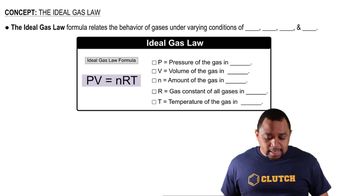
The Ideal Gas Law relates the pressure, volume, temperature, and number of moles of a gas through the equation PV = nRT. This law is essential for calculating the pressure of gases under varying conditions, allowing us to predict how changes in temperature or volume affect gas behavior.
Video consigliato:
Percorso guidato
01:15
Ideal Gas Law Formula

Molar Mass and Moles

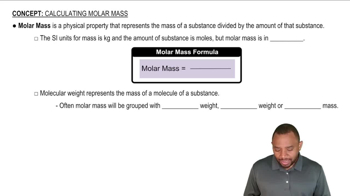
Molar mass is the mass of one mole of a substance, typically expressed in grams per mole. To use the Ideal Gas Law, it is necessary to convert the mass of propane (1.30 g) into moles by dividing by its molar mass (44.1 g/mol), which is crucial for determining the number of moles (n) in the equation.
Video consigliato:
Percorso guidato
02:11
Molar Mass Concept

Gas Pressure and Temperature Relationship

According to Gay-Lussac's Law, the pressure of a gas is directly proportional to its absolute temperature when volume is held constant. This relationship is important for understanding how increasing the temperature of the aerosol can (to 50 °C) will increase the pressure inside the can, potentially leading to a burst.
Video consigliato:
Percorso guidato
01:08
Standard Temperature and Pressure