
Ch.10 - Gases
Brown - Chemistry: The Central Science 14th Edition
Brown14th EditionChemistry: The Central ScienceISBN: 9780134414232Non è quello che usi tu?Cambia libro di testo
Capitolo 10, Problema 106a

Assume that a single cylinder of an automobile engine has a volume of 524 cm3. (a) If the cylinder is full of air at 74 C and 99.3 kPa, how many moles of O2 are present? (The mole fraction of O2 in dry air is 0.2095.) (b) How many grams of C8H18 could be combusted by this quantity of O2, assuming complete combustion with formation of CO2 and H2O?

Guida verificata passo dopo passo
1
Step 1: Convert the temperature from Celsius to Kelvin by using the formula T(K) = T(°C) + 273.15. This will be used in the ideal gas law equation.
Step 2: Use the ideal gas law, PV = nRT, to calculate the total number of moles of air in the cylinder. Here, P is the pressure, V is the volume, n is the number of moles, R is the gas constant (0.0821 L·atm/K·mol for consistency in units), and T is the temperature in Kelvin.
Step 3: Calculate the number of moles of O2 by multiplying the total moles of air by the mole fraction of O2 in air (0.2095).
Step 4: Use the stoichiometry of the combustion reaction of octane (C8H18) with oxygen to determine how many moles of C8H18 can be combusted by the available moles of O2. The balanced equation is 2 C8H18 + 25 O2 → 16 CO2 + 18 H2O.
Step 5: Convert the moles of C8H18 to grams by multiplying by the molar mass of C8H18 (114.23 g/mol).

Risposta video verificata per un problema simile:

Questa soluzione video è stata consigliata dai nostri tutor come utile per risolvere questo problema.
Durata del video:
3m

Concetti chiave

Ecco i concetti essenziali che devi comprendere per rispondere correttamente alla domanda.

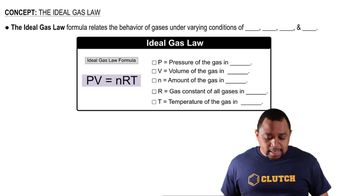
Ideal Gas Law

The Ideal Gas Law relates the pressure, volume, temperature, and number of moles of a gas through the equation PV = nRT. This law is essential for calculating the number of moles of a gas in a given volume and conditions. In this question, it will be used to determine the moles of O2 present in the cylinder of the engine.
Video consigliato:
Percorso guidato
01:15
Ideal Gas Law Formula

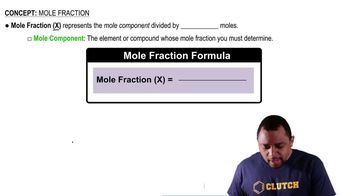
Mole Fraction

Mole fraction is a way of expressing the concentration of a component in a mixture, defined as the ratio of the number of moles of that component to the total number of moles in the mixture. In this case, the mole fraction of O2 in dry air (0.2095) allows us to calculate the specific amount of O2 present in the cylinder based on the total moles of air.
Video consigliato:
Percorso guidato
00:36
Mole Fraction Formula

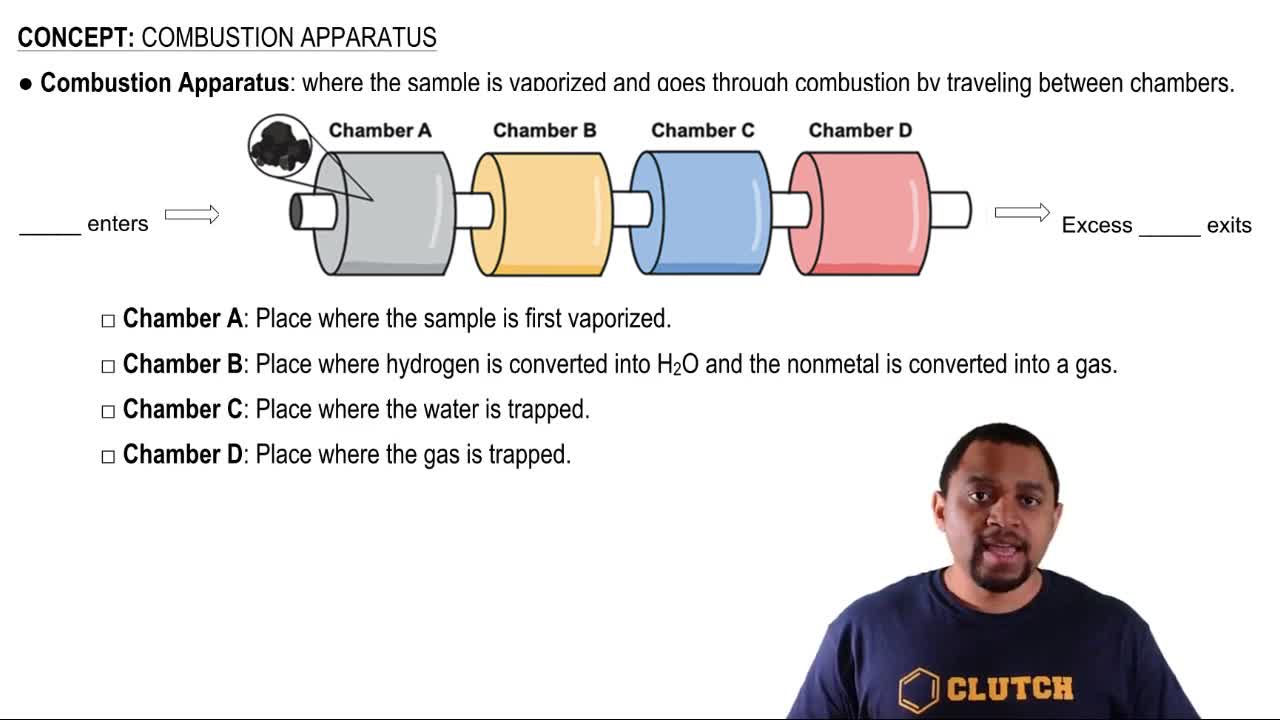
Combustion Reaction

A combustion reaction is a chemical process in which a substance (typically a hydrocarbon) reacts with oxygen to produce carbon dioxide and water, releasing energy. Understanding the stoichiometry of the combustion of C8H18 (octane) is crucial for determining how much of this fuel can be combusted with the available O2, based on the balanced chemical equation.
Video consigliato:
Percorso guidato
02:24
Combustion Apparatus
Pratica correlata
Domanda del libro di testo
Nickel carbonyl, Ni1CO24, is one of the most toxic substances known. The present maximum allowable concentration in laboratory air during an 8-hr workday is 1 ppb (parts per billion) by volume, which means that there is one mole of Ni1CO24 for every 109 moles of gas. Assume 24 C and 101.3 kPa pressure. What mass of Ni1CO24 is allowable in a laboratory room that is 3.5 m * 6.0 m * 2.5 m?
713
views
Domanda del libro di testo

Assume that an exhaled breath of air consists of 74.8% N2, 15.3% O2, 3.7% CO2, and 6.2% water vapor. (a) If the total pressure of the gases is 99.8 kPa, calculate the partial pressure of each component of the mixture.

999
views
Domanda del libro di testo

Assume that an exhaled breath of air consists of 74.8% N2, 15.3% O2, 3.7% CO2, and 6.2% water vapor. (b) If the volume of the exhaled gas is 455 mL and its temperature is 37 °C, calculate the number of moles of CO2 exhaled.

1
views
Domanda del libro di testo
Propane, C3H8, liquefies under modest pressure, allowing a large amount to be stored in a container. (a) Calculate the number of moles of propane gas in a 20-L container at 709.3 kPa and 25 C. (b) Calculate the number of moles of liquid propane that can be stored in the same volume if the density of the liquid is 0.590 g/mL. (c) Calculate the ratio of the number of moles of liquid to moles of gas. Discuss this ratio in light of the kinetic-molecular theory of gases.
1167
views
Domanda del libro di testo

Assume that an exhaled breath of air consists of 74.8% N2, 15.3% O2, 3.7% CO2, and 6.2% water vapor. (c) How many grams of glucose (C6H12O6) would need to be metabolized to produce this quantity of CO2? (The chemical reaction is the same as that for combustion of C6H12O6. See Section 3.2 and Problem 10.57.)

518
views
Domanda del libro di testo

Consider the arrangement of bulbs shown in the drawing. Each of the bulbs contains a gas at the pressure shown. What is the pressure of the system when all the stopcocks are opened, assuming that the temperature remains constant? (We can neglect the volume of the capillary tubing connecting the bulbs.)

1529
views