
Ch.10 - Gases
Brown - Chemistry: The Central Science 14th Edition
Brown14th EditionChemistry: The Central ScienceISBN: 9780134414232Non è quello che usi tu?Cambia libro di testo
Capitolo 10, Problema 14c

(c) Which is most likely to be a gas at room temperature and ordinary atmospheric pressure, F2, Br2, K2O?

Guida verificata passo dopo passo
1
Identify the types of substances: \( \text{F}_2 \) and \( \text{Br}_2 \) are diatomic molecules, while \( \text{K}_2\text{O} \) is an ionic compound.
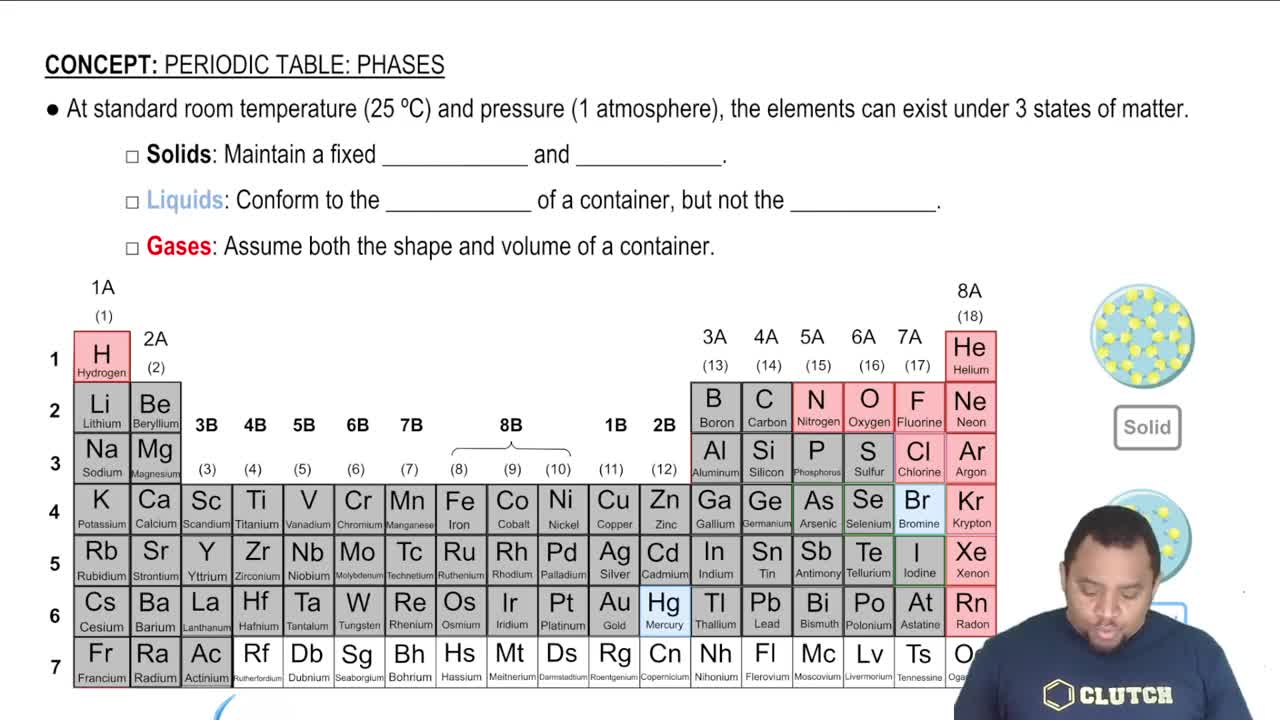
Consider the physical states of diatomic molecules: \( \text{F}_2 \) is a halogen gas, \( \text{Br}_2 \) is a liquid at room temperature, and \( \text{K}_2\text{O} \) is a solid.
Recall the general trend for halogens: As you move down the group in the periodic table, the boiling points increase, making \( \text{F}_2 \) more likely to be a gas than \( \text{Br}_2 \).
Consider the nature of ionic compounds: \( \text{K}_2\text{O} \) is an ionic compound, which typically exists as a solid at room temperature due to strong ionic bonds.
Conclude that \( \text{F}_2 \), being a diatomic molecule with a low boiling point, is most likely to be a gas at room temperature and ordinary atmospheric pressure.

Risposta video verificata per un problema simile:

Questa soluzione video è stata consigliata dai nostri tutor come utile per risolvere questo problema.
Durata del video:
5m

Concetti chiave

Ecco i concetti essenziali che devi comprendere per rispondere correttamente alla domanda.

States of Matter

The states of matter—solid, liquid, and gas—are determined by the arrangement and energy of particles. Gases have particles that are far apart and move freely, while solids have closely packed particles that vibrate in place. Understanding these states helps predict which substances will be gaseous at room temperature and pressure.
Video consigliato:
Percorso guidato
03:25
Element States of Matter

Molecular Weight and Intermolecular Forces

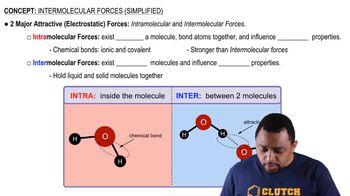
Molecular weight influences the physical state of a substance. Generally, lighter molecules with weaker intermolecular forces are more likely to be gases at room temperature. For example, fluorine (F2) is a diatomic molecule with a low molecular weight, making it more likely to exist as a gas compared to heavier molecules like bromine (Br2).
Video consigliato:
Percorso guidato
01:59
Intermolecular vs Intramolecular Forces

Phase Diagrams

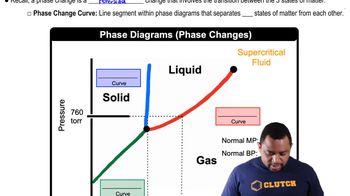
Phase diagrams illustrate the states of a substance under varying temperature and pressure conditions. They help determine the phase (solid, liquid, or gas) of a substance at specific conditions. By analyzing the phase behavior of F2, Br2, and K2O, one can predict which is most likely to be a gas at room temperature and ordinary atmospheric pressure.
Video consigliato:
Percorso guidato
03:22
Phase Changes in Diagrams