

Ch.10 - Gases
Brown - Chemistry: The Central Science 14th Edition
Brown14th EditionChemistry: The Central ScienceISBN: 9780134414232Non è quello che usi tu?Cambia libro di testo
Capitolo 10, Problema 33

Complete the following table for an ideal gas: P V n T 101.33 kPa ? L 3.333 mol 300 K

Guida verificata passo dopo passo
1
Identify the ideal gas law equation: PV = nRT.
Rearrange the equation to solve for the unknown variable, V: V = \(\frac{nRT}{P}\).
Substitute the given values into the equation: n = 3.333 \(\text{ mol}\), R = 8.314 \(\text{ J/(mol K)}\), T = 300 \(\text{ K}\), P = 101.33 \(\text{ kPa}\).
Convert the pressure from kPa to Pa for consistency with the gas constant R: 1 \(\text{ kPa}\) = 1000 \(\text{ Pa}\), so P = 101.33 \(\times\) 1000 \(\text{ Pa}\).
Calculate the volume V using the rearranged equation and the substituted values.

Risposta video verificata per un problema simile:

Questa soluzione video è stata consigliata dai nostri tutor come utile per risolvere questo problema.
Durata del video:
7m

Concetti chiave

Ecco i concetti essenziali che devi comprendere per rispondere correttamente alla domanda.

Ideal Gas Law

The Ideal Gas Law is a fundamental equation in chemistry that relates the pressure (P), volume (V), number of moles (n), and temperature (T) of an ideal gas. It is expressed as PV = nRT, where R is the ideal gas constant. This law allows us to predict the behavior of gases under various conditions and is essential for solving problems involving gas properties.
Video consigliato:
Percorso guidato
01:15
Ideal Gas Law Formula

Pressure and Volume Relationship

In the context of the Ideal Gas Law, pressure and volume are inversely related when the number of moles and temperature are held constant. This means that if the volume of a gas increases, its pressure decreases, and vice versa. Understanding this relationship is crucial for manipulating the Ideal Gas Law to find unknown variables.
Video consigliato:
Percorso guidato
01:09
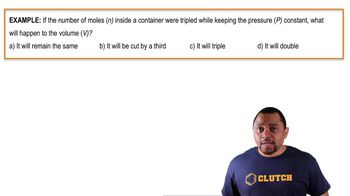
Relationship of Volume and Moles Example

Units of Measurement

In chemistry, it is important to use consistent units when applying the Ideal Gas Law. Pressure is often measured in atmospheres (atm) or pascals (Pa), volume in liters (L), and temperature in Kelvin (K). The ideal gas constant R also has different values depending on the units used, so ensuring unit consistency is vital for accurate calculations.
Video consigliato:
Percorso guidato
02:52
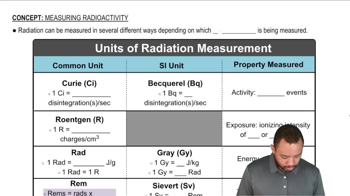
Units of Radiation Measurement