Ch.10 - Gases
Brown - Chemistry: The Central Science 14th Edition
Brown14th EditionChemistry: The Central ScienceISBN: 9780134414232Non è quello che usi tu?Cambia libro di testo
Capitolo 10, Problema 113d

Consider the following gases, all at STP: Ne, SF6, N2, CH4. (d) Which one has the highest total molecular volume relative to the space occupied by the gas?

Guida verificata passo dopo passo
1
Understand that at STP (Standard Temperature and Pressure), all gases occupy the same volume per mole, which is 22.4 L.
Recognize that the total molecular volume of a gas is related to the size of its molecules and the number of molecules present.
Consider that the molecular volume of a gas is negligible compared to the volume it occupies at STP, but larger molecules will have a slightly higher molecular volume.
Compare the molecular sizes: Ne (neon) is a noble gas with small atomic size, SF_6 (sulfur hexafluoride) is a large molecule due to its six fluorine atoms, N_2 (nitrogen) is a diatomic molecule, and CH_4 (methane) is a small tetrahedral molecule.
Conclude that SF_6, being the largest molecule among the given gases, will have the highest total molecular volume relative to the space occupied by the gas.

Risposta video verificata per un problema simile:

Questa soluzione video è stata consigliata dai nostri tutor come utile per risolvere questo problema.
Durata del video:
1m

Concetti chiave

Ecco i concetti essenziali che devi comprendere per rispondere correttamente alla domanda.

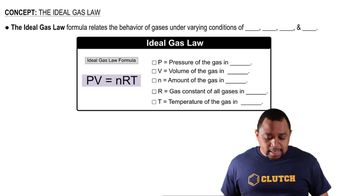
Ideal Gas Law

The Ideal Gas Law (PV=nRT) describes the relationship between pressure (P), volume (V), temperature (T), and the number of moles (n) of a gas. At standard temperature and pressure (STP), gases behave ideally, allowing for the comparison of their volumes. Understanding this law is crucial for analyzing how different gases occupy space under the same conditions.
Video consigliato:
Percorso guidato
01:15
Ideal Gas Law Formula

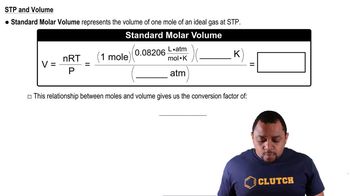
Molar Volume of Gases

At STP, one mole of an ideal gas occupies a volume of 22.4 liters. This concept allows for the comparison of the volumes of different gases based on their molar masses and molecular structures. Gases with larger molar masses or more complex structures may occupy more space, influencing their total molecular volume.
Video consigliato:
Percorso guidato
01:21
Standard Molar Volume

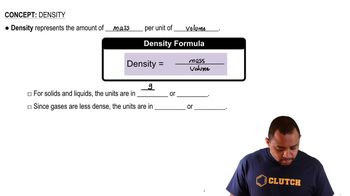
Density of Gases

The density of a gas is defined as its mass per unit volume. It is influenced by the molecular weight and the conditions of temperature and pressure. In the context of the question, understanding the densities of Ne, SF6, N2, and CH4 helps determine which gas has the highest total molecular volume relative to the space it occupies, as denser gases will have more mass in the same volume.
Video consigliato:
Percorso guidato
01:56
Density Concepts