
The apparatus shown here has two gas-filled containers and one empty container, all attached to a hollow horizontal tube. Assume that the containers are of equal volume and ignore the volume of the connecting tube. Which gas has the greater partial pressure after the valves are opened?
Ch.10 - Gases
Brown14th EditionChemistry: The Central ScienceISBN: 9780134414232Non è quello che usi tu?Cambia libro di testo
Capitolo 10, Problema 9b
Consider the following graph. (b) If A and B refer to the same gas at two different temperatures, which represents the higher temperature?
Guida verificata passo dopo passo1
Identify the axes of the graph. Typically, a graph involving gases will have pressure (P) on the y-axis and volume (V) on the x-axis.
Recall the ideal gas law: PV = nRT, where T is the temperature. For a given amount of gas (n) and constant R, the relationship between P and V at different temperatures can be analyzed.
Understand that at higher temperatures, the gas molecules have more kinetic energy, which affects the pressure and volume relationship.
Recognize that for the same gas at different temperatures, the curve representing the higher temperature will be further from the origin in a PV graph. This is because at higher temperatures, for the same volume, the pressure is higher.
Determine which curve (A or B) is further from the origin, indicating it represents the higher temperature.

Risposta video verificata per un problema simile:
Questa soluzione video è stata consigliata dai nostri tutor come utile per risolvere questo problema.
Durata del video:
1mConcetti chiave
Ecco i concetti essenziali che devi comprendere per rispondere correttamente alla domanda.
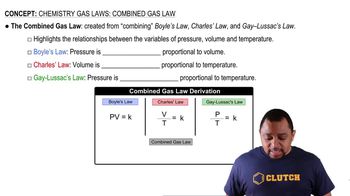
Gas Laws
Gas laws describe the behavior of gases in relation to pressure, volume, and temperature. The most relevant laws include Boyle's Law, Charles's Law, and the Ideal Gas Law, which collectively explain how changes in temperature affect gas properties. Understanding these laws is crucial for interpreting graphs that depict gas behavior under varying conditions.
Video consigliato:
Percorso guidato
Combined Gas Law
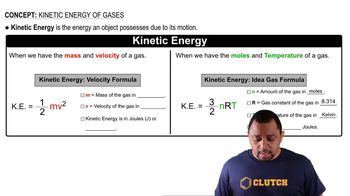
Temperature and Kinetic Energy
Temperature is a measure of the average kinetic energy of the particles in a substance. In gases, higher temperatures correspond to greater kinetic energy, leading to increased particle movement. This relationship is fundamental when comparing the states of a gas at different temperatures, as it directly influences pressure and volume.
Video consigliato:
Percorso guidato
Kinetic Energy Formulas
Graph Interpretation
Interpreting graphs involves analyzing the plotted data to extract meaningful information. In the context of gas behavior, a graph may show temperature on one axis and another variable (like pressure or volume) on the other. Understanding how to read these graphs is essential for determining which conditions correspond to higher or lower temperatures based on the data presented.
Video consigliato:
Percorso guidato
Intepreting the Band of Stability
Pratica correlata
Domanda del libro di testo
704
views
Domanda del libro di testo
Consider the following samples of gases:
If the three samples are all at the same temperature, rank them with respect to (c) density
431
views
Domanda del libro di testo
Consider the following samples of gases:
If the three samples are all at the same temperature, rank them with respect to (a) total pressure
783
views
Domanda del libro di testo
Consider the following graph. (c) For each curve, which speed is highest: the most probable speed, the root-mean-square speed, or the average speed?
534
views
Domanda del libro di testo
Consider the following graph. (a) If curves A and B refer to two different gases, He and O2, at the same temperature, which curve corresponds to He?
599
views
