
Ch.10 - Gases
Brown - Chemistry: The Central Science 14th Edition
Brown14th EditionChemistry: The Central ScienceISBN: 9780134414232Non è quello che usi tu?Cambia libro di testo
Capitolo 10, Problema 118b

Cyclopropane, a gas used with oxygen as a general anesthetic, is composed of 85.7% C and 14.3% H by mass. (b) Judging from its molecular formula, would you expect cyclopropane to deviate more or less than Ar from ideal-gas behavior at moderately high pressures and room temperature? Explain.

Guida verificata passo dopo passo
1
To determine if cyclopropane would deviate more or less from ideal-gas behavior compared to argon (Ar), we need to consider the factors that cause deviations from ideal behavior. These include intermolecular forces and the size of the molecules.
Ideal gases are assumed to have no intermolecular forces and occupy no volume. Real gases deviate from this behavior due to the presence of intermolecular forces and the finite volume of the gas particles.
Cyclopropane (C₃H₆) is a larger and more complex molecule than argon, which is a noble gas with a single atom. Cyclopropane has stronger intermolecular forces (such as van der Waals forces) due to its molecular structure.
At moderately high pressures, the volume of the gas particles and the intermolecular forces become significant. Cyclopropane, with its larger size and stronger intermolecular forces, is likely to deviate more from ideal-gas behavior than argon.
In summary, due to its molecular complexity and the presence of intermolecular forces, cyclopropane is expected to deviate more from ideal-gas behavior than argon at moderately high pressures and room temperature.

Risposta video verificata per un problema simile:

Questa soluzione video è stata consigliata dai nostri tutor come utile per risolvere questo problema.
Durata del video:
1m

Concetti chiave

Ecco i concetti essenziali che devi comprendere per rispondere correttamente alla domanda.

Ideal Gas Law

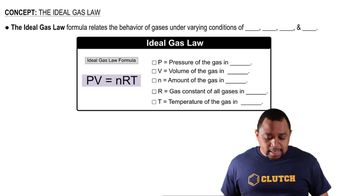
The Ideal Gas Law describes the behavior of ideal gases through the equation PV=nRT, where P is pressure, V is volume, n is the number of moles, R is the ideal gas constant, and T is temperature. Ideal gases are assumed to have no intermolecular forces and occupy no volume, which allows them to perfectly follow this law under all conditions. However, real gases deviate from this behavior under high pressure and low temperature due to interactions between molecules and their finite volume.
Video consigliato:
Percorso guidato
01:15
Ideal Gas Law Formula

Molecular Structure and Polarity

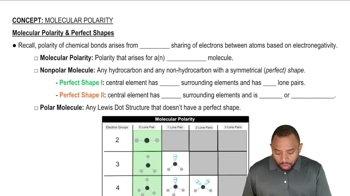
Cyclopropane is a small, cyclic hydrocarbon with a molecular formula of C3H6. Its structure leads to unique properties, including angle strain due to the 60-degree bond angles in the three-membered ring. This strain can affect the molecule's interactions with other molecules, influencing its behavior under various conditions, such as pressure and temperature, and potentially leading to deviations from ideal gas behavior.
Video consigliato:
Percorso guidato
02:38
Molecular Polarity

Real Gas Behavior

Real gases deviate from ideal gas behavior primarily due to intermolecular forces and the volume occupied by gas molecules. At moderately high pressures, the volume of the gas becomes significant compared to the container, and attractive forces between molecules can lead to condensation. Cyclopropane, being a small and relatively polar molecule, is likely to experience these effects more than a noble gas, which behaves more ideally under similar conditions.
Video consigliato:
Percorso guidato
01:15
Ideal Gas Law Formula
Pratica correlata
Domanda del libro di testo

An herbicide is found to contain only C, H, N, and Cl. The complete combustion of a 100.0-mg sample of the herbicide in excess oxygen produces 83.16 mL of CO2 and 73.30 mL of H2O vapor expressed at STP. A separate analysis shows that the sample also contains 16.44 mg of Cl. (c) What other information would you need to know about this compound to calculate its true molecular formula?

679
views
Domanda del libro di testo

Cyclopropane, a gas used with oxygen as a general anesthetic, is composed of 85.7% C and 14.3% H by mass. (a) If 1.56 g of cyclopropane has a volume of 1.00 L at 99.7 kPa and 50.0 °C, what is the molecular formula of cyclopropane?

1381
views
Domanda del libro di testo

An herbicide is found to contain only C, H, N, and Cl. The complete combustion of a 100.0-mg sample of the herbicide in excess oxygen produces 83.16 mL of CO2 and 73.30 mL of H2O vapor expressed at STP. A separate analysis shows that the sample also contains 16.44 mg of Cl. (b) Calculate its empirical formula.

1707
views
Domanda del libro di testo

Large amounts of nitrogen gas are used in the manufacture of ammonia, principally for use in fertilizers. Suppose 120.00 kg of N2(g) is stored in a 1100.0-L metal cylinder at 280 °C. (c) Under the conditions of this problem, which correction dominates, the one for finite volume of gas molecules or the one for attractive interactions?

Domanda del libro di testo

Large amounts of nitrogen gas are used in the manufacture of ammonia, principally for use in fertilizers. Suppose 120.00 kg of N2(g) is stored in a 1100.0-L metal cylinder at 280 °C. (b) By using the data in Table 10.3, calculate the pressure of the gas according to the van der Waals equation.

932
views