
Ch.10 - Gases
Brown - Chemistry: The Central Science 14th Edition
Brown14th EditionChemistry: The Central ScienceISBN: 9780134414232Non è quello che usi tu?Cambia libro di testo
Capitolo 10, Problema 66

A plasma-screen TV contains thousands of tiny cells filled with a mixture of Xe, Ne, and He gases that emits light of specific wavelengths when a voltage is applied. A particular plasma cell, 0.900 mm * 0.300 mm * 10.0 mm, contains 4% Xe in a 1:1 Ne:He mixture at a total pressure of 66.66 kPa. Calculate the number of Ne atoms in the cell and state the assumptions you need to make in your calculation.

Guida verificata passo dopo passo
1
Convert the dimensions of the plasma cell from millimeters to meters to find the volume in cubic meters.
Calculate the total volume of the plasma cell using the formula: \( V = \text{length} \times \text{width} \times \text{height} \).
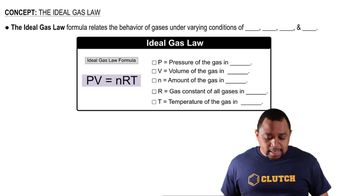
Use the ideal gas law \( PV = nRT \) to find the total number of moles of gas in the cell, assuming ideal gas behavior.
Determine the mole fraction of Ne in the mixture. Since the mixture is 4% Xe and a 1:1 Ne:He mixture, calculate the mole fraction of Ne.
Calculate the number of Ne atoms by multiplying the moles of Ne by Avogadro's number (\(6.022 \times 10^{23}\) atoms/mol).

Risposta video verificata per un problema simile:

Questa soluzione video è stata consigliata dai nostri tutor come utile per risolvere questo problema.
Durata del video:
11m

Concetti chiave

Ecco i concetti essenziali che devi comprendere per rispondere correttamente alla domanda.

Ideal Gas Law

The Ideal Gas Law relates the pressure, volume, temperature, and number of moles of a gas through the equation PV = nRT. This law is essential for calculating the number of gas particles in a given volume under specific conditions. In this problem, it will help determine the number of moles of the gas mixture in the plasma cell, which can then be converted to the number of atoms.
Video consigliato:
Percorso guidato
01:15
Ideal Gas Law Formula

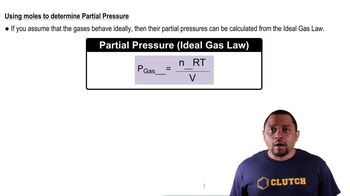
Partial Pressure

Partial pressure is the pressure that each gas in a mixture would exert if it occupied the entire volume alone. According to Dalton's Law of Partial Pressures, the total pressure of a gas mixture is the sum of the partial pressures of its individual components. This concept is crucial for calculating the contribution of neon (Ne) to the total pressure in the plasma cell, allowing for the determination of its mole fraction.
Video consigliato:
Percorso guidato
00:48
Partial Pressure Calculation

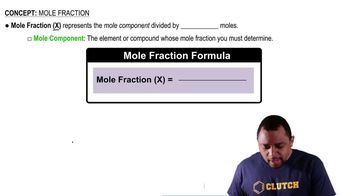
Mole Fraction

Mole fraction is a way of expressing the concentration of a component in a mixture, defined as the ratio of the number of moles of that component to the total number of moles of all components. In this scenario, knowing the mole fraction of neon in the gas mixture will enable the calculation of the total number of Ne atoms present in the plasma cell, based on the total number of moles derived from the Ideal Gas Law.
Video consigliato:
Percorso guidato
00:36
Mole Fraction Formula