

Ch.10 - Gases
Brown - Chemistry: The Central Science 14th Edition
Brown14th EditionChemistry: The Central ScienceISBN: 9780134414232Non è quello che usi tu?Cambia libro di testo
Capitolo 10, Problema 126d

Gaseous iodine pentafluoride, IF5, can be prepared by the reaction of solid iodine and gaseous fluorine: I2(s) + 5 F2(g) → 2 IF5(g) A 5.00-L flask containing 10.0 g of I2 is charged with 10.0 g of F2, and the reaction proceeds until one of the reagents is completely consumed. After the reaction is complete, the temperature in the flask is 125 °C. (d) What is the total mass of reactants and products in the flask?

Guida verificata passo dopo passo
1
Calculate the molar mass of iodine (I2) and fluorine (F2) to determine how many moles of each are present initially. The molar mass of I2 is approximately 253.8 g/mol and for F2 it is about 38.0 g/mol.
Use the stoichiometry of the balanced chemical equation, I2(s) + 5 F2(g) → 2 IF5(g), to determine which reactant is the limiting reactant. This can be done by comparing the mole ratio of I2 to F2 from the initial amounts with the mole ratio required by the balanced equation.
Calculate the amount of IF5 produced by using the limiting reactant's amount and the stoichiometry of the reaction. Since the reaction produces 2 moles of IF5 for every 1 mole of I2 reacted, use this ratio to find the moles of IF5 formed.
Determine the mass of IF5 produced using its molar mass (calculated by adding the molar masses of I and 5 F atoms).
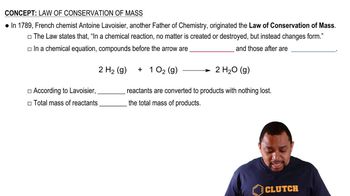
Add the mass of the unreacted excess reactant to the mass of the IF5 produced to find the total mass in the flask after the reaction. The law of conservation of mass states that the total mass before and after the reaction in a closed system must be the same.

Risposta video verificata per un problema simile:

Questa soluzione video è stata consigliata dai nostri tutor come utile per risolvere questo problema.
Durata del video:
9m

Concetti chiave

Ecco i concetti essenziali che devi comprendere per rispondere correttamente alla domanda.

Law of Conservation of Mass

The Law of Conservation of Mass states that mass is neither created nor destroyed in a chemical reaction. This principle implies that the total mass of the reactants must equal the total mass of the products. In the context of the given reaction, this means that the combined mass of iodine and fluorine before the reaction will be equal to the mass of iodine pentafluoride produced after the reaction.
Video consigliato:
Percorso guidato
01:48
Law of Conservation of Mass

Stoichiometry

Stoichiometry is the calculation of reactants and products in chemical reactions based on balanced chemical equations. It allows us to determine the amounts of substances consumed and produced in a reaction. In this case, understanding the stoichiometric ratios from the balanced equation for the reaction of iodine and fluorine is essential to identify how much of each reactant is used and how much product is formed.
Video consigliato:
Percorso guidato
01:16
Stoichiometry Concept

Molar Mass

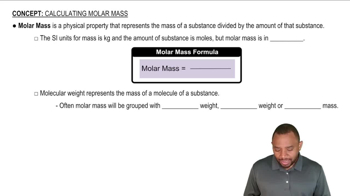
Molar mass is the mass of one mole of a substance, typically expressed in grams per mole (g/mol). It is crucial for converting between the mass of a substance and the number of moles, which is necessary for stoichiometric calculations. In this problem, calculating the molar masses of iodine (I2) and fluorine (F2) will help determine the initial amounts of reactants in moles, facilitating the analysis of the reaction's outcome.
Video consigliato:
Percorso guidato
02:11
Molar Mass Concept
Pratica correlata
Domanda del libro di testo

Gaseous iodine pentafluoride, IF5, can be prepared by the reaction of solid iodine and gaseous fluorine: I2(s) + 5 F2(g) → 2 IF5(g) A 5.00-L flask containing 10.0 g of I2 is charged with 10.0 g of F2, and the reaction proceeds until one of the reagents is completely consumed. After the reaction is complete, the temperature in the flask is 125 °C.  (c) Draw the Lewis structure of IF5.

992
views
Domanda del libro di testo

A 6.53-g sample of a mixture of magnesium carbonate and calcium carbonate is treated with excess hydrochloric acid. The resulting reaction produces 1.72 L of carbon dioxide gas at 28 °C and 99.06 kPa pressure. (c) Assuming that the reactions are complete, calculate the percentage by mass of magnesium carbonate in the mixture.

1568
views
Domanda del libro di testo

Gaseous iodine pentafluoride, IF5, can be prepared by the reaction of solid iodine and gaseous fluorine: I2(s) + 5 F2(g) → 2 IF5(g) A 5.00-L flask containing 10.0 g of I2 is charged with 10.0 g of F2, and the reaction proceeds until one of the reagents is completely consumed. After the reaction is complete, the temperature in the flask is 125 °C. (b) What is the mole fraction of IF5 in the flask?

Domanda del libro di testo

A 6.53-g sample of a mixture of magnesium carbonate and calcium carbonate is treated with excess hydrochloric acid. The resulting reaction produces 1.72 L of carbon dioxide gas at 28 °C and 99.06 kPa pressure. (a) Write balanced chemical equations for the reactions that occur between hydrochloric acid and each component of the mixture.

Domanda del libro di testo

Gaseous iodine pentafluoride, IF5, can be prepared by the reaction of solid iodine and gaseous fluorine: I2(s) + 5 F2(g) → 2 IF5(g) A 5.00-L flask containing 10.0 g of I2 is charged with 10.0 g of F2, and the reaction proceeds until one of the reagents is completely consumed. After the reaction is complete, the temperature in the flask is 125 °C. (a) What is the partial pressure of IF5 in the flask?

982
views