

Ch.10 - Gases
Brown - Chemistry: The Central Science 14th Edition
Brown14th EditionChemistry: The Central ScienceISBN: 9780134414232Non è quello che usi tu?Cambia libro di testo
Capitolo 10, Problema 125a

Natural gas is very abundant in many Middle Eastern oil fields. However, the costs of shipping the gas to markets in other parts of the world are high because it is necessary to liquefy the gas, which is mainly methane and has a boiling point at atmospheric pressure of -164 °C. One possible strategy is to oxidize the methane to methanol, CH3OH, which has a boiling point of 65 °C and can therefore be shipped more readily. Suppose that 3.03×10⁸ m3 of methane at atmospheric pressure and 25 °C is oxidized to methanol. (a) What volume of methanol is formed if the density of CH3OH is 0.791 g/mL?

Guida verificata passo dopo passo
1
Step 1: Convert the volume of methane from cubic meters to liters by using the conversion factor 1 m^3 = 1000 L.
Step 2: Use the ideal gas law, PV = nRT, to calculate the number of moles of methane. Assume the gas behaves ideally, use R = 0.0821 L atm K^{-1} mol^{-1}, and convert the temperature from Celsius to Kelvin.
Step 3: Write the balanced chemical equation for the oxidation of methane to methanol. The equation is CH4 + 1.5 O2 -> CH3OH + H2O.
Step 4: Use stoichiometry from the balanced equation to find the moles of methanol produced from the moles of methane calculated.
Step 5: Convert the moles of methanol to volume using the density of methanol (0.791 g/mL). First, calculate the mass of methanol by multiplying the moles by the molar mass of methanol (32.04 g/mol), then convert the mass to volume.

Risposta video verificata per un problema simile:

Questa soluzione video è stata consigliata dai nostri tutor come utile per risolvere questo problema.
Durata del video:
8m

Concetti chiave

Ecco i concetti essenziali che devi comprendere per rispondere correttamente alla domanda.

Stoichiometry

Stoichiometry is the branch of chemistry that deals with the quantitative relationships between the reactants and products in a chemical reaction. It allows us to calculate the amounts of substances consumed and produced in a reaction based on balanced chemical equations. In this case, understanding the stoichiometry of the oxidation of methane to methanol is essential for determining the volume of methanol produced from a given volume of methane.
Video consigliato:
Percorso guidato
01:16
Stoichiometry Concept

Gas Laws

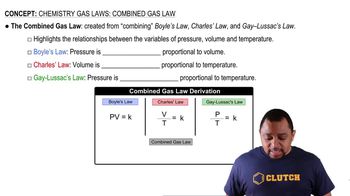
Gas laws describe the behavior of gases in relation to pressure, volume, and temperature. The ideal gas law (PV=nRT) is particularly useful for converting between the volume of a gas at specific conditions and the number of moles. In this question, the volume of methane at atmospheric pressure and temperature must be converted to moles to find the corresponding volume of methanol produced after the reaction.
Video consigliato:
Percorso guidato
01:43
Combined Gas Law

Density and Volume Conversion

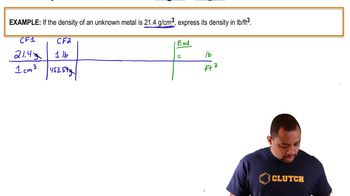
Density is defined as mass per unit volume and is a critical concept for converting between mass and volume of a substance. In this scenario, the density of methanol (0.791 g/mL) is used to convert the mass of methanol produced into its volume. Understanding how to apply density in calculations is crucial for determining the final volume of methanol that can be shipped.
Video consigliato:
Percorso guidato
05:30
Density Conversion Example