Ch.10 - Gases
Brown - Chemistry: The Central Science 14th Edition
Brown14th EditionChemistry: The Central ScienceISBN: 9780134414232Non è quello che usi tu?Cambia libro di testo
Capitolo 10, Problema 19e

The highest barometric pressure ever recorded was 823.7 torr at Agata in Siberia, Russia on December 31, 1968. Convert this pressure to (e) psi.

Guida verificata passo dopo passo
1
Identify the given pressure in torr: 823.7 torr.
Recall the conversion factor between torr and psi: 1 atm = 760 torr and 1 atm = 14.696 psi.
Convert the pressure from torr to atm using the conversion factor: \( \text{Pressure in atm} = \frac{823.7 \text{ torr}}{760 \text{ torr/atm}} \).
Convert the pressure from atm to psi using the conversion factor: \( \text{Pressure in psi} = \text{Pressure in atm} \times 14.696 \text{ psi/atm} \).
Perform the calculations to find the pressure in psi.

Risposta video verificata per un problema simile:

Questa soluzione video è stata consigliata dai nostri tutor come utile per risolvere questo problema.
Durata del video:
1m

Concetti chiave

Ecco i concetti essenziali che devi comprendere per rispondere correttamente alla domanda.

Barometric Pressure

Barometric pressure is the pressure exerted by the weight of the atmosphere at a given point. It is commonly measured in units such as torr, pascals, or atmospheres. Understanding barometric pressure is essential for various applications, including weather forecasting and studying atmospheric phenomena.
Video consigliato:

Unit Conversion

Unit conversion is the process of converting a quantity expressed in one set of units to another set of units. In this case, converting pressure from torr to psi (pounds per square inch) requires using a conversion factor. Mastery of unit conversion is crucial in chemistry and physics to ensure accurate calculations and comparisons.
Video consigliato:
Percorso guidato
01:56
Conversion Factors

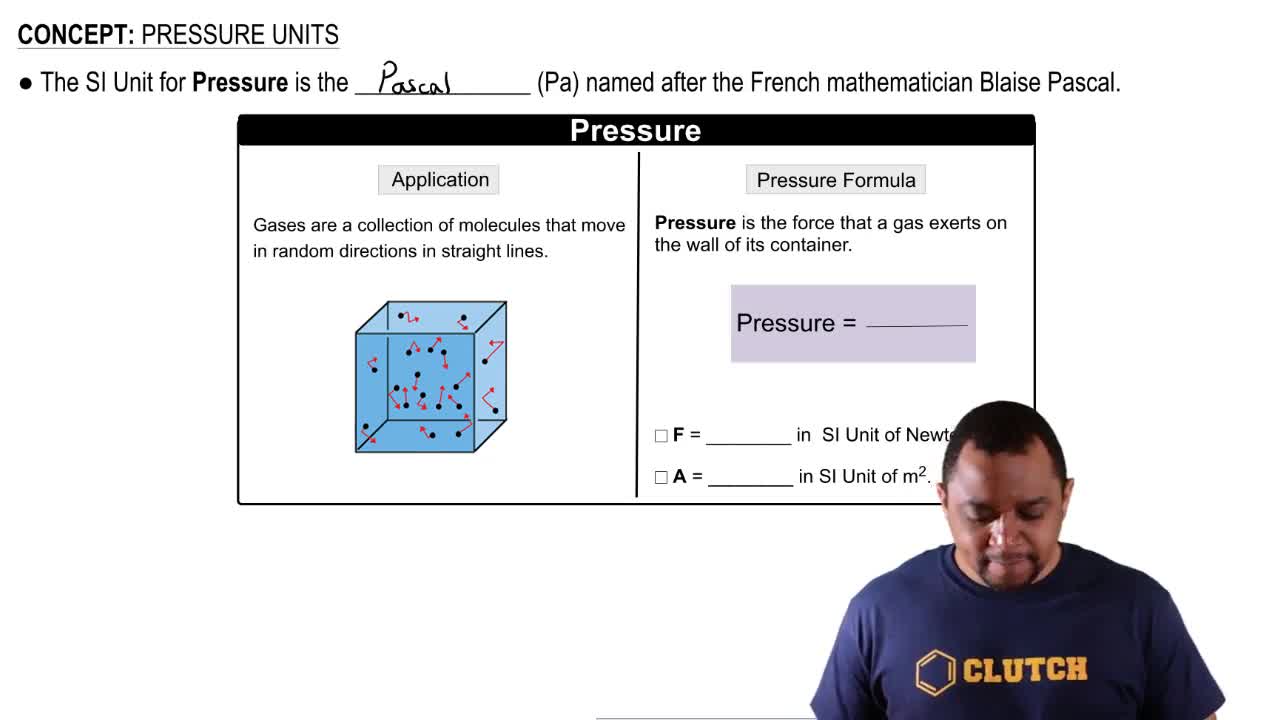
Pressure Units

Pressure is a measure of force applied per unit area, and it can be expressed in various units, including torr, psi, and pascals. Each unit has its own context and application; for example, psi is commonly used in engineering and automotive contexts. Understanding these units and their relationships is vital for interpreting and communicating scientific data.
Video consigliato: