Ch.10 - Gases
Brown - Chemistry: The Central Science 14th Edition
Brown14th EditionChemistry: The Central ScienceISBN: 9780134414232Non è quello che usi tu?Cambia libro di testo
Capitolo 10, Problema 25c

You have a gas at 25 C confined to a cylinder with a movable piston. Which of the following actions would double the gas pressure? (a) Lifting up on the piston to double the volume while keeping the temperature constant (b) Heating the gas so that its temperature rises from 25 C to 50 C, while keeping the volume constant (c) Pushing down on the piston to halve the volume while keeping the temperature constant.

Guida verificata passo dopo passo
1
Identify the initial conditions of the gas: constant temperature at 25°C and a certain volume.
Recall the ideal gas law: \( PV = nRT \), where \( P \) is pressure, \( V \) is volume, \( n \) is the number of moles, \( R \) is the gas constant, and \( T \) is temperature in Kelvin.
Convert the given temperature from Celsius to Kelvin: \( T(K) = 25 + 273.15 \).
Analyze each option: (a) Doubling the volume while keeping temperature constant will halve the pressure, according to Boyle's Law (\( P_1V_1 = P_2V_2 \)). (b) Doubling the temperature in Kelvin will double the pressure if volume is constant, according to Gay-Lussac's Law (\( \frac{P_1}{T_1} = \frac{P_2}{T_2} \)). (c) Halving the volume while keeping temperature constant will double the pressure, according to Boyle's Law.
Determine which action results in doubling the pressure: Option (c) is correct, as halving the volume while keeping temperature constant will double the pressure.

Risposta video verificata per un problema simile:

Questa soluzione video è stata consigliata dai nostri tutor come utile per risolvere questo problema.
Durata del video:
3m

Concetti chiave

Ecco i concetti essenziali che devi comprendere per rispondere correttamente alla domanda.

Ideal Gas Law

The Ideal Gas Law, represented as PV = nRT, relates the pressure (P), volume (V), and temperature (T) of an ideal gas. It shows that for a given amount of gas (n) at a constant temperature, pressure is inversely proportional to volume. This means that if the volume decreases, the pressure increases, assuming temperature remains constant.
Video consigliato:
Percorso guidato
01:15
Ideal Gas Law Formula

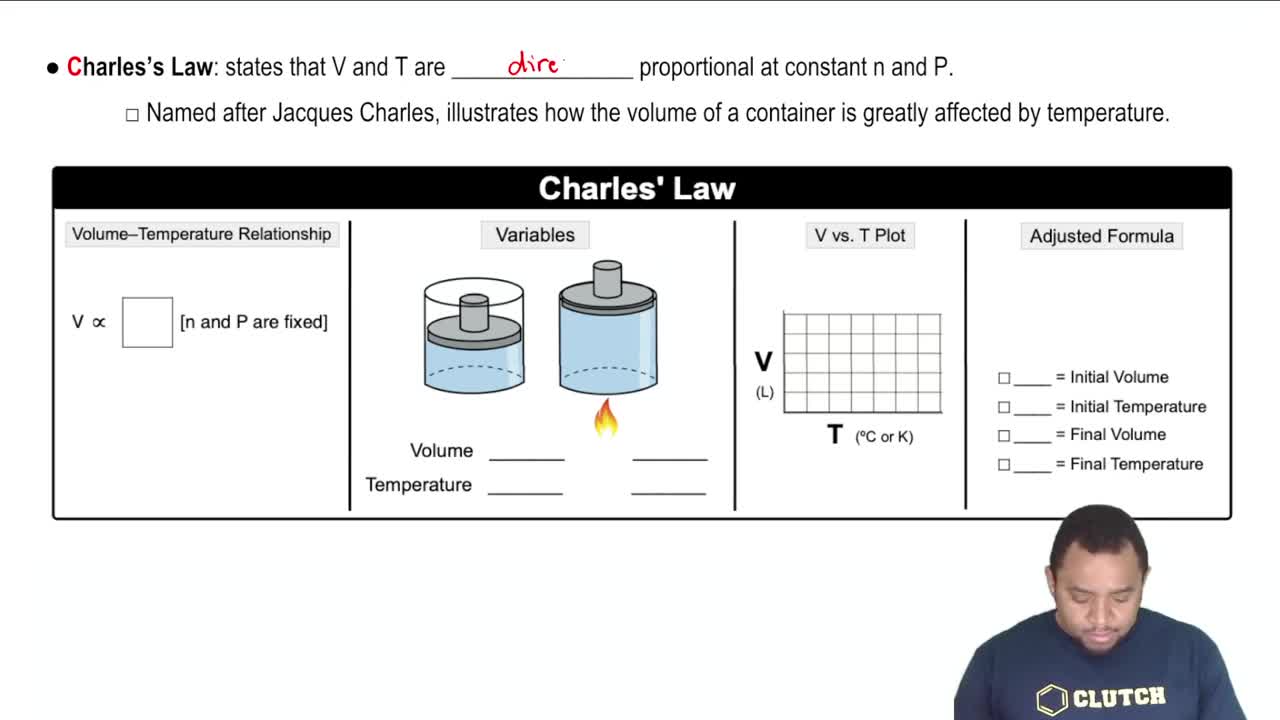
Charles's Law

Charles's Law states that the volume of a gas is directly proportional to its temperature when pressure is held constant. This means that increasing the temperature of a gas will increase its volume, which can affect the pressure if the volume is not allowed to change. Understanding this law helps in analyzing how temperature changes impact gas behavior.
Video consigliato:

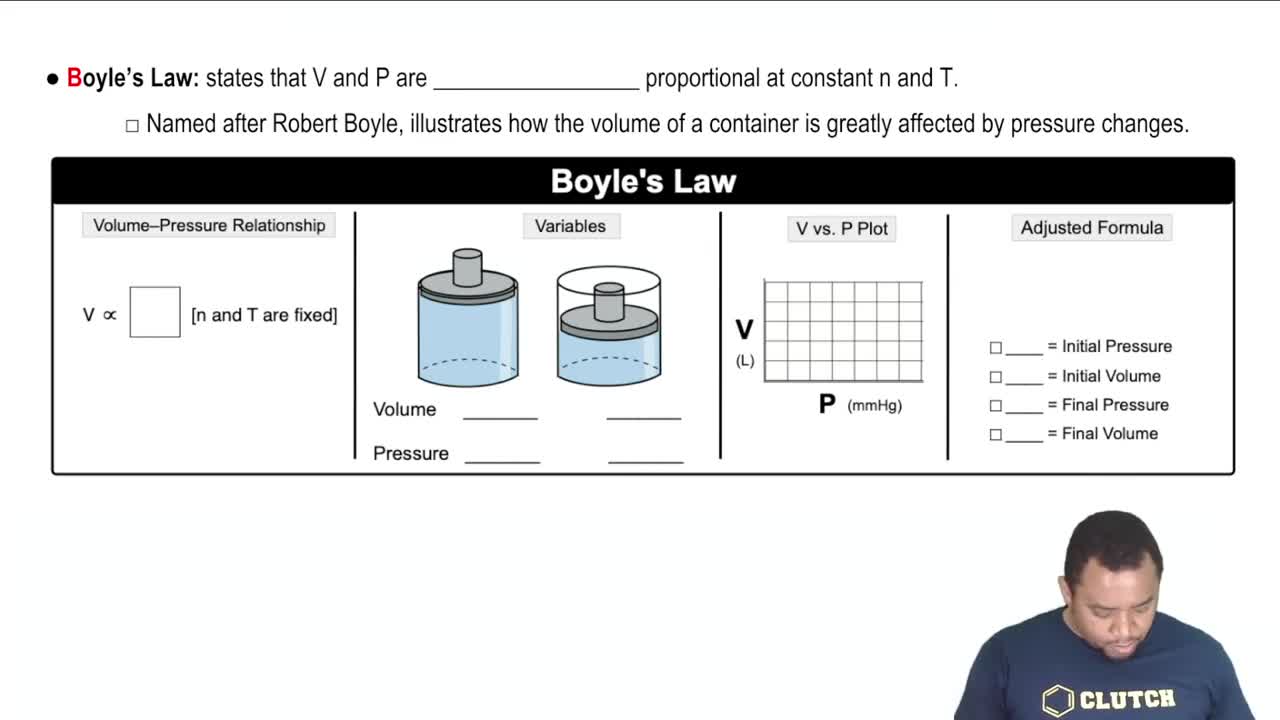
Boyle's Law

Boyle's Law states that the pressure of a gas is inversely proportional to its volume when temperature is held constant. This means that if the volume of a gas is halved, the pressure will double, provided the temperature does not change. This principle is crucial for understanding how compressing a gas affects its pressure.
Video consigliato: