
You are high up in the mountains and boil water to make some tea. However, when you drink your tea, it is not as hot as it should be. You try again and again, but the water is just not hot enough to make a hot cup of tea. Which is the best explanation for this result? (a) High in the mountains, it is probably very dry, and so the water is rapidly evaporating from your cup and cooling it. (b) High in the mountains, it is probably very windy, and so the water is rapidly evaporating from your cup and cooling it. (c) High in the mountains, the air pressure is significantly less than 1 atm, so the boiling point of water is much lower than at sea level. (d) High in the mountains, the air pressure is significantly less than 1 atm, so the boiling point of water is much higher than at sea level.
Ch.11 - Liquids and Intermolecular Forces

Brown14th EditionChemistry: The Central ScienceISBN: 9780134414232
Non è quello che usi tu?Cambia libro di testoScegli un libro di testo diverso
TOC.tableOfContents
- Ch.1 - Introduction: Matter, Energy, and Measurement177
- Ch.2 - Atoms, Molecules, and Ions231
- Ch.3 - Chemical Reactions and Reaction Stoichiometry216
- Ch.4 - Reactions in Aqueous Solution189
- Ch.5 - Thermochemistry175
- Ch.6 - Electronic Structure of Atoms168
- Ch.7 - Periodic Properties of the Elements150
- Ch.8 - Basic Concepts of Chemical Bonding177
- Ch.9 - Molecular Geometry and Bonding Theories200
- Ch.10 - Gases179
- Ch.11 - Liquids and Intermolecular Forces113
- Ch.12 - Solids and Modern Materials154
- Ch.13 - Properties of Solutions157
- Ch.14 - Chemical Kinetics199
- Ch.15 - Chemical Equilibrium128
- Ch.16 - Acid-Base Equilibria164
- Ch.17 - Additional Aspects of Aqueous Equilibria163
- Ch.18 - Chemistry of the Environment105
- Ch.19 - Chemical Thermodynamics164
- Ch.20 - Electrochemistry171
- Ch.21 - Nuclear Chemistry122
- Ch.22 - Chemistry of the Nonmetals82
- Ch.23 - Transition Metals and Coordination Chemistry79
- Ch.24 - The Chemistry of Life: Organic and Biological Chemistry16
Brown14th EditionChemistry: The Central ScienceISBN: 9780134414232Non è quello che usi tu?Cambia libro di testo
Capitolo 11, Problema 53a
(a) Two pans of water are on different burners of a stove. One pan of water is boiling vigorously, while the other is boiling gently. What can be said about the temperature of the water in the two pans?
 Guida verificata passo dopo passo
1
Understand that boiling occurs when a liquid's vapor pressure equals the atmospheric pressure.
Recognize that the boiling point of water at standard atmospheric pressure is 100°C (212°F).
Realize that once water reaches its boiling point, additional heat does not increase the temperature but instead converts more water into steam.
Acknowledge that both pans of water, whether boiling vigorously or gently, are at the same temperature, which is the boiling point of water.
Conclude that the difference in the intensity of boiling is due to the rate of heat being supplied, not a difference in temperature.
Risposta video verificata per un problema simile:
Questa soluzione video è stata consigliata dai nostri tutor come utile per risolvere questo problema.

Durata del video:
2mConcetti chiave
Ecco i concetti essenziali che devi comprendere per rispondere correttamente alla domanda.
Boiling Point
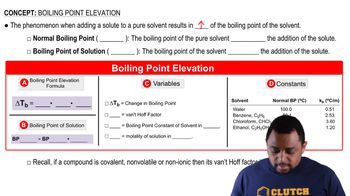
The boiling point of a substance is the temperature at which its vapor pressure equals the atmospheric pressure, causing it to change from liquid to gas. For water, this occurs at 100°C (212°F) at standard atmospheric pressure. Regardless of the intensity of boiling, once water reaches its boiling point, its temperature remains constant until all the liquid has vaporized.
Video consigliato:
Percorso guidato
 03:05
03:05
Boiling Point Elevation
Heat Transfer
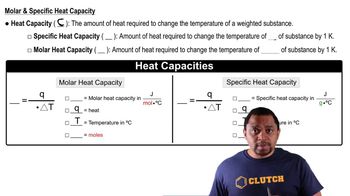
Heat transfer is the process of thermal energy moving from one object to another due to a temperature difference. In the context of boiling water, the burner provides heat to the pan, causing the water to absorb energy. The vigorous boiling indicates a higher rate of heat transfer, but the temperature of the water remains at the boiling point, regardless of the boiling intensity.
Video consigliato:
Percorso guidato
 02:19
02:19Heat Capacity
Phase Change
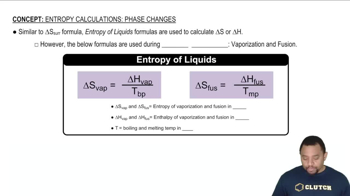
A phase change occurs when a substance transitions between solid, liquid, and gas states. During boiling, water undergoes a phase change from liquid to gas. This process requires energy, known as the heat of vaporization, and occurs at a constant temperature, meaning that both pans of water, despite differing boiling intensities, are at the same temperature when boiling.
Video consigliato:
Percorso guidato
 01:46
01:46Entropy in Phase Changes
Pratica correlata
Domanda del libro di testo
1034
views
Domanda del libro di testo
(a) Place the following substances in order of increasing volatility: CH4, CBr4, CH2Cl2, CH3Cl, CHBr3, and CH2Br2. (b) How do the boiling points vary through this series? (c) Explain your answer to part (b) in terms of intermolecular forces.
3117
views
1
rank
Domanda del libro di testo
Using the vapor-pressure curves in Figure 11.25, (d) estimate the external pressure at which diethyl ether will boil at 40 °C.
1151
views