Ch.11 - Liquids and Intermolecular Forces
Brown - Chemistry: The Central Science 14th Edition
Brown14th EditionChemistry: The Central ScienceISBN: 9780134414232Non è quello che usi tu?Cambia libro di testo
Capitolo 11, Problema 33c

(c) Why do substances with high surface tension also tend to have high viscosities?

Guida verificata passo dopo passo
1
Understand the concept of surface tension: Surface tension is the energy required to increase the surface area of a liquid due to intermolecular forces. It is a measure of how difficult it is to stretch or break the surface of a liquid.
Understand the concept of viscosity: Viscosity is a measure of a fluid's resistance to flow. It describes how thick or sticky a liquid is, which is also influenced by intermolecular forces.
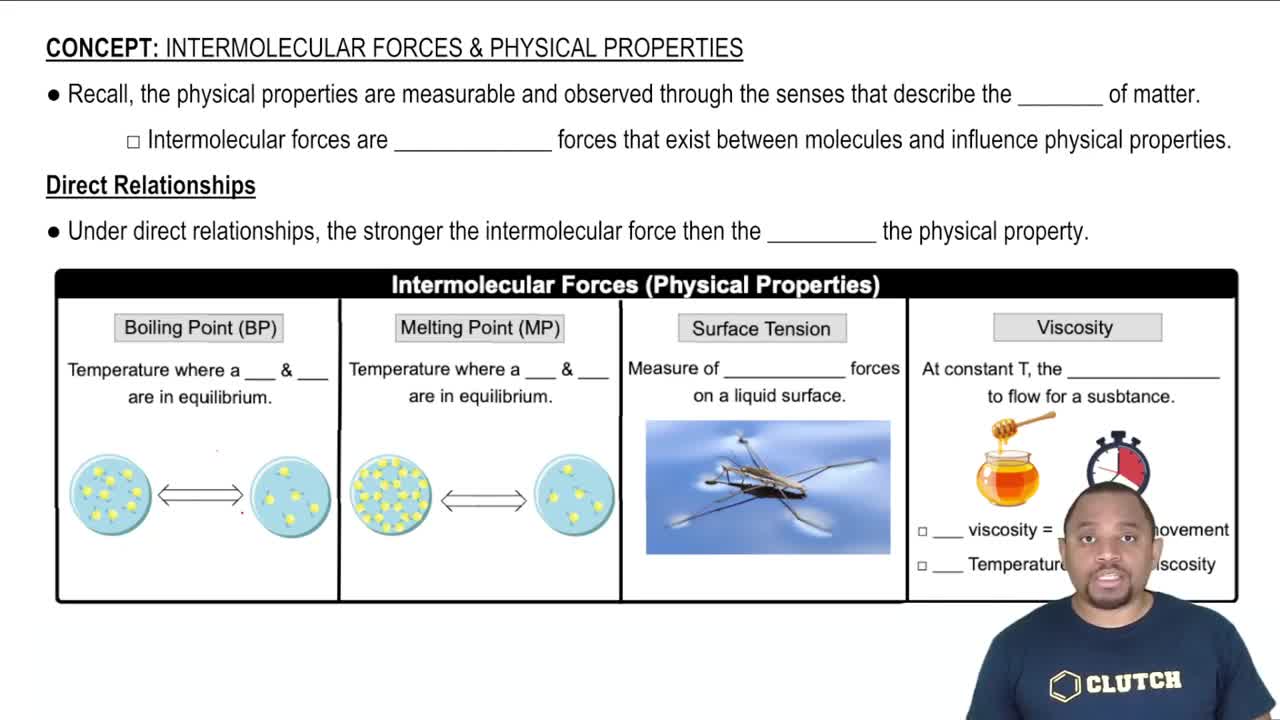
Recognize the role of intermolecular forces: Both surface tension and viscosity are influenced by the strength of intermolecular forces within a liquid. Stronger intermolecular forces lead to higher surface tension and higher viscosity.
Connect surface tension and viscosity: Substances with high surface tension have strong cohesive forces at the surface, which also contribute to the resistance to flow within the liquid, resulting in high viscosity.
Conclude the relationship: Therefore, substances with high surface tension tend to have high viscosities because both properties are dependent on the strength of intermolecular forces within the liquid.

Risposta video verificata per un problema simile:

Questa soluzione video è stata consigliata dai nostri tutor come utile per risolvere questo problema.
Durata del video:
1m

Concetti chiave

Ecco i concetti essenziali che devi comprendere per rispondere correttamente alla domanda.

Surface Tension

Surface tension is the cohesive force between liquid molecules at the surface, caused by intermolecular attractions. It results in a 'skin' effect, allowing objects to float or insects to walk on water. Substances with strong intermolecular forces, such as hydrogen bonding, exhibit higher surface tension.
Video consigliato:
Percorso guidato
03:13
Intermolecular Forces and Properties

Viscosity

Viscosity is a measure of a fluid's resistance to flow, influenced by the internal friction between molecules. Higher viscosity indicates a thicker fluid that flows more slowly. It is affected by temperature and the strength of intermolecular forces; stronger forces lead to higher viscosity.
Video consigliato:
Percorso guidato
03:13
Intermolecular Forces and Properties

Intermolecular Forces

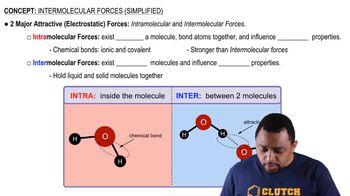
Intermolecular forces are the attractive forces between molecules, including hydrogen bonds, dipole-dipole interactions, and London dispersion forces. Substances with strong intermolecular forces tend to have both high surface tension and high viscosity, as these forces create a more cohesive and resistant liquid structure.
Video consigliato:
Percorso guidato
01:59
Intermolecular vs Intramolecular Forces