Name the phase transition in each of the following situations and indicate whether it is exothermic or endothermic: (d) Molten lava from a volcano turns into solid rock.
Ch.11 - Liquids and Intermolecular Forces
Brown14th EditionChemistry: The Central ScienceISBN: 9780134414232Non è quello che usi tu?Cambia libro di testo
Capitolo 11, Problema 42b
Ethyl chloride (C2H5Cl) boils at 12 °C. When liquid C2H5Cl under pressure is sprayed on a room-temperature (25 °C) surface in air, the surface is cooled considerably. (b) Assume that the heat lost by the surface is gained by ethyl chloride. What enthalpies must you consider if you were to calculate the final temperature of the surface?
Guida verificata passo dopo passo1
Step 1: Identify the processes involved. In this case, we have the boiling of ethyl chloride (C2H5Cl) and the cooling of the surface.
Step 2: Recognize that the heat lost by the surface is gained by the ethyl chloride. This is an application of the law of conservation of energy, which states that energy cannot be created or destroyed, only transferred or transformed.
Step 3: Understand that the enthalpy of vaporization of ethyl chloride is involved. This is the energy required to convert a substance from a liquid to a gas at its boiling point. It is absorbed by the ethyl chloride as it vaporizes.
Step 4: Consider the enthalpy of cooling of the surface. This is the energy released by the surface as it cools down. It is transferred to the ethyl chloride.
Step 5: Note that the final temperature of the surface will be determined by the balance between these two enthalpies. If the enthalpy of vaporization of ethyl chloride is greater than the enthalpy of cooling of the surface, the surface will cool down. If it's less, the surface will heat up.

Risposta video verificata per un problema simile:
Questa soluzione video è stata consigliata dai nostri tutor come utile per risolvere questo problema.
Durata del video:
1mConcetti chiave
Ecco i concetti essenziali che devi comprendere per rispondere correttamente alla domanda.
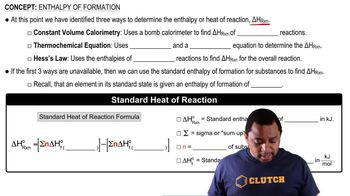
Enthalpy
Enthalpy is a thermodynamic property that represents the total heat content of a system. It is defined as the sum of the internal energy and the product of pressure and volume. In chemical processes, changes in enthalpy (ΔH) indicate the heat absorbed or released during reactions or phase changes, which is crucial for understanding heat transfer in the context of ethyl chloride cooling the surface.
Video consigliato:
Percorso guidato
Enthalpy of Formation
Heat Transfer
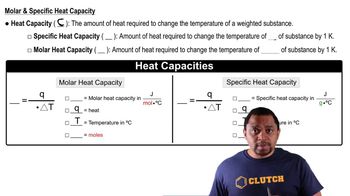
Heat transfer refers to the movement of thermal energy from one object or substance to another due to a temperature difference. In this scenario, the heat lost by the warmer surface is transferred to the ethyl chloride, causing the surface to cool. Understanding the mechanisms of heat transfer—conduction, convection, and radiation—is essential for calculating the final temperature of the surface after contact with the ethyl chloride.
Video consigliato:
Percorso guidato
Heat Capacity
Phase Change
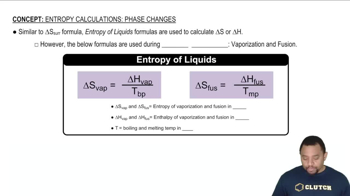
Phase change is the transition of a substance from one state of matter to another, such as from liquid to gas. In the case of ethyl chloride, when it is sprayed, it may evaporate, absorbing heat from the surface. The enthalpy of vaporization, which is the heat required to convert a unit mass of a liquid into vapor without a change in temperature, plays a critical role in determining how much heat is absorbed and how it affects the final temperature of the surface.
Video consigliato:
Percorso guidato
Entropy in Phase Changes
Pratica correlata
Domanda del libro di testo
354
views
Domanda del libro di testo
For many years drinking water has been cooled in hot climates by evaporating it from the surfaces of canvas bags or porous clay pots. How many grams of water can be cooled from 35 to 20 °C by the evaporation of 60 g of water? (The heat of vaporization of water in this temperature range is 2.4 kJ/g. The specific heat of water is 4.18 J/g-K).
2118
views
Domanda del libro di testo
Ethyl chloride (C2H5Cl) boils at 12 °C. When liquid C2H5Cl under pressure is sprayed on a room-temperature (25 °C) surface in air, the surface is cooled considerably. (a) What does this observation tell us about the specific heat of C2H5Cl(g) as compared with that of C2H5Cl(l)?
835
views
1
rank
1
comments