Ch.11 - Liquids and Intermolecular Forces
Brown - Chemistry: The Central Science 14th Edition
Brown14th EditionChemistry: The Central ScienceISBN: 9780134414232Non è quello che usi tu?Cambia libro di testo
Capitolo 11, Problema 67a,b,d,e,f

Indicate whether each statement is true or false: (a) The liquid crystal state is another phase of matter, just like solid, liquid, and gas. (b) Liquid crystalline molecules are generally spherical in shape. (d) Molecules that exhibit a liquid crystalline phase show weaker-than-expected intermolecular forces. (e) Molecules containing only carbon and hydrogen are likely to form liquid crystalline phases. (f) Molecules can exhibit more than one liquid crystalline phase.

Guida verificata passo dopo passo
1
Step 1: Understand the concept of liquid crystals. Liquid crystals are a state of matter that have properties between those of conventional liquids and solid crystals. They can flow like a liquid but have some degree of order like a solid.
Step 2: Evaluate statement (a). Liquid crystals are indeed considered another phase of matter, distinct from solid, liquid, and gas. This statement is true.
Step 3: Evaluate statement (b). Liquid crystalline molecules are typically not spherical; they are often elongated or rod-like, which allows them to align in a specific direction. This statement is false.
Step 4: Evaluate statement (d). Molecules that exhibit a liquid crystalline phase often have strong intermolecular forces that allow them to maintain some order while still flowing. This statement is false.
Step 5: Evaluate statement (f). Molecules can exhibit more than one liquid crystalline phase, such as nematic, smectic, and cholesteric phases, depending on temperature and molecular structure. This statement is true.

Risposta video verificata per un problema simile:

Questa soluzione video è stata consigliata dai nostri tutor come utile per risolvere questo problema.
Durata del video:
4m

Concetti chiave

Ecco i concetti essenziali che devi comprendere per rispondere correttamente alla domanda.

Liquid Crystals

Liquid crystals are a unique state of matter that exhibit properties between those of liquids and solid crystals. They can flow like a liquid but have some degree of order, particularly in their molecular arrangement. This phase is characterized by the ability of molecules to align in specific orientations, which is crucial for applications in displays and other technologies.
Video consigliato:
Percorso guidato
03:04
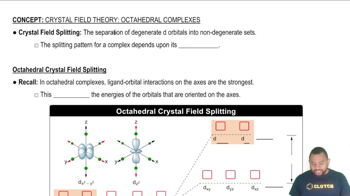
The crystal field splitting pattern for octahedral complexes has the d orbitals on or along the axes as having the higher energy.

Molecular Shape and Structure

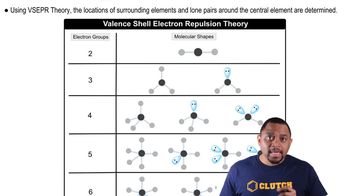
The shape and structure of molecules significantly influence their ability to form liquid crystalline phases. While many liquid crystalline molecules are elongated or rod-like, not all are spherical. The molecular geometry affects how they pack and interact, which in turn impacts their phase behavior and the strength of intermolecular forces.
Video consigliato:
Percorso guidato
02:13
Molecular Shapes and VSEPR

Intermolecular Forces

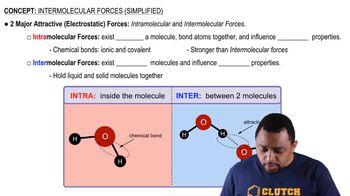
Intermolecular forces are the attractive forces between molecules that determine the physical properties of substances, including their phase behavior. In liquid crystals, these forces can be weaker than expected due to the unique arrangement and orientation of the molecules, which can lead to distinct phase transitions and behaviors compared to typical solids and liquids.
Video consigliato:
Percorso guidato
01:59
Intermolecular vs Intramolecular Forces