
Ch.11 - Liquids and Intermolecular Forces
Brown - Chemistry: The Central Science 14th Edition
Brown14th EditionChemistry: The Central ScienceISBN: 9780134414232Non è quello che usi tu?Cambia libro di testo
Capitolo 11, Problema 5a

Using this graph of CS2 data, determine (a) the approximate vapor pressure of CS2 at 30°C,

Guida verificata passo dopo passo
1
Step 1: Locate the point on the graph that corresponds to a temperature of 30°C. This will be along the x-axis (horizontal axis) of the graph, which typically represents temperature in a vapor pressure graph.
Step 2: From the point at 30°C, draw a line straight up until it intersects with the curve representing the vapor pressure of CS2.
Step 3: Once your line intersects with the curve, draw a line horizontally from that point to the y-axis (vertical axis), which typically represents vapor pressure in a vapor pressure graph.
Step 4: The point where your horizontal line intersects with the y-axis is the approximate vapor pressure of CS2 at 30°C.
Step 5: Read off the value from the y-axis. This is your approximate vapor pressure of CS2 at 30°C. Remember, this is an approximation based on the graph and may not be the exact value.

Risposta video verificata per un problema simile:

Questa soluzione video è stata consigliata dai nostri tutor come utile per risolvere questo problema.
Durata del video:
39s

Concetti chiave

Ecco i concetti essenziali che devi comprendere per rispondere correttamente alla domanda.

Vapor Pressure

Vapor pressure is the pressure exerted by a vapor in equilibrium with its liquid or solid phase at a given temperature. It reflects the tendency of particles to escape from the liquid phase into the vapor phase. Higher temperatures generally increase vapor pressure, as more molecules have sufficient energy to overcome intermolecular forces.
Video consigliato:
Percorso guidato
02:40
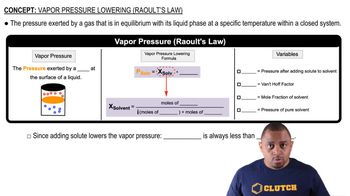
Raoult's Law and Vapor Pressure

Phase Equilibrium

Phase equilibrium occurs when the rates of the forward and reverse processes of a phase change are equal, resulting in no net change in the amount of each phase. In the context of vapor pressure, this means that the number of molecules evaporating from the liquid equals the number condensing back into it, allowing for a stable vapor pressure at a specific temperature.
Video consigliato:
Percorso guidato
03:22
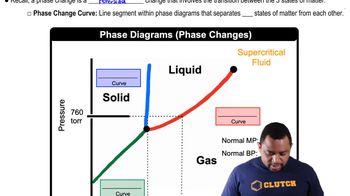
Phase Changes in Diagrams

Temperature Dependence of Vapor Pressure

The vapor pressure of a substance is highly dependent on temperature, typically increasing as temperature rises. This relationship is often described by the Clausius-Clapeyron equation, which relates the change in vapor pressure with temperature to the enthalpy of vaporization. Understanding this concept is crucial for interpreting vapor pressure data at different temperatures.
Video consigliato:
Percorso guidato
02:40
Raoult's Law and Vapor Pressure