Ch.12 - Solids and Modern Materials
Brown - Chemistry: The Central Science 14th Edition
Brown14th EditionChemistry: The Central ScienceISBN: 9780134414232Non è quello che usi tu?Cambia libro di testo
Capitolo 12, Problema 121

Germanium has the same structure as silicon, but the unit cell size is different because Ge and Si atoms are not the same size. If you were to repeat the experiment described in the previous problem but replace the Si crystal with a Ge crystal, would you expect the X rays to be diffracted at a larger or smaller angle u?

Guida verificata passo dopo passo
1
Understand that the problem involves X-ray diffraction, which is described by Bragg's Law: \(n\lambda = 2d\sin\theta\), where \(n\) is the order of reflection, \(\lambda\) is the wavelength of the X-rays, \(d\) is the distance between atomic planes, and \(\theta\) is the angle of diffraction.
Recognize that the problem is asking about the change in the angle of diffraction (\(\theta\)) when the crystal is changed from silicon (Si) to germanium (Ge).
Recall that germanium (Ge) and silicon (Si) have the same crystal structure, but the atomic size of Ge is larger than that of Si, which means the distance between atomic planes (\(d\)) in Ge is larger than in Si.
According to Bragg's Law, if the distance \(d\) increases and the wavelength \(\lambda\) remains constant, the angle \(\theta\) must adjust to satisfy the equation. Specifically, for a given order \(n\), an increase in \(d\) would result in a decrease in \(\sin\theta\), which implies a smaller angle \(\theta\).
Conclude that replacing the Si crystal with a Ge crystal would result in the X-rays being diffracted at a smaller angle \(\theta\).

Risposta video verificata per un problema simile:

Questa soluzione video è stata consigliata dai nostri tutor come utile per risolvere questo problema.
Durata del video:
2m

Concetti chiave

Ecco i concetti essenziali che devi comprendere per rispondere correttamente alla domanda.

Bragg's Law

Bragg's Law relates the angle of diffraction of X-rays to the spacing between atomic planes in a crystal. It is expressed as nλ = 2d sin(θ), where n is an integer, λ is the wavelength of the X-rays, d is the distance between crystal planes, and θ is the angle of diffraction. Understanding this law is crucial for predicting how changes in atomic spacing affect diffraction angles.
Video consigliato:

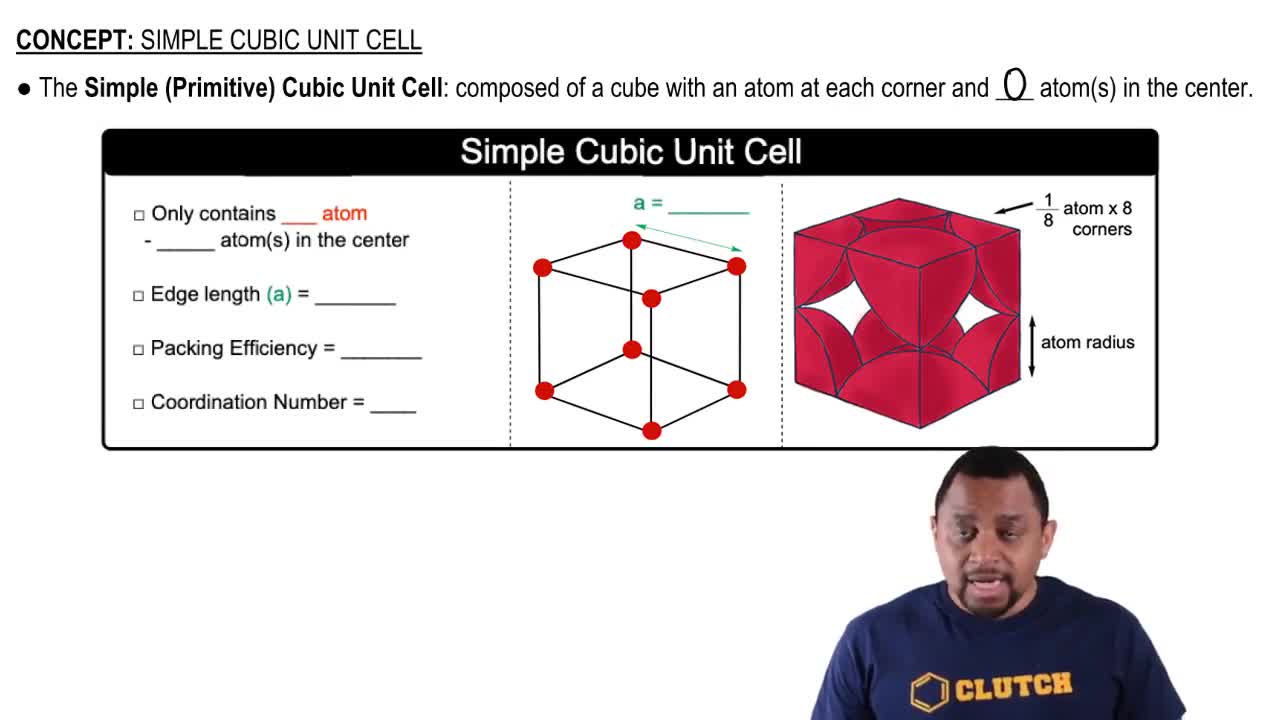
Crystal Structure and Unit Cell

The crystal structure refers to the orderly arrangement of atoms in a crystalline solid, characterized by its unit cell, the smallest repeating unit that defines the entire structure. In this case, germanium (Ge) and silicon (Si) have similar structures but different unit cell sizes due to the differing atomic radii. This difference in size affects the spacing of atomic planes, which in turn influences the diffraction pattern.
Video consigliato:
Percorso guidato
01:27
Simple Cubic Unit Cell

Atomic Radius and Diffraction Angles

The atomic radius is the distance from the nucleus of an atom to the outermost electron shell. In the context of X-ray diffraction, a larger atomic radius in Ge compared to Si results in a larger unit cell and increased interplanar spacing. Consequently, this larger spacing leads to a change in the diffraction angle, typically resulting in smaller angles for larger unit cells, as per Bragg's Law.
Video consigliato: