Ch.12 - Solids and Modern Materials
Brown - Chemistry: The Central Science 14th Edition
Brown14th EditionChemistry: The Central ScienceISBN: 9780134414232Non è quello che usi tu?Cambia libro di testo
Capitolo 12, Problema 48

An increase in temperature causes most metals to undergo thermal expansion, which means the volume of the metal increases upon heating. How does thermal expansion affect the unit cell length? What is the effect of an increase in temperature on the density of a metal?

Guida verificata passo dopo passo
1
Thermal expansion refers to the increase in volume of a material as its temperature increases. For metals, this means that the atoms vibrate more vigorously and tend to occupy more space, leading to an expansion of the material's dimensions.
In a crystalline solid, the smallest repeating unit is the unit cell. As the metal expands due to increased temperature, the dimensions of the unit cell, including its length, will also increase. This is because the atoms within the unit cell move slightly further apart.
Density is defined as mass per unit volume (\( \rho = \frac{m}{V} \)). As the temperature increases, the volume of the metal increases due to thermal expansion, while the mass remains constant.
Since the volume increases and the mass stays the same, the density of the metal will decrease. This is because the same amount of mass is now spread over a larger volume.
In summary, an increase in temperature causes the unit cell length of a metal to increase due to thermal expansion, and as a result, the density of the metal decreases because the volume increases while the mass remains constant.

Risposta video verificata per un problema simile:

Questa soluzione video è stata consigliata dai nostri tutor come utile per risolvere questo problema.
Durata del video:
2m

Concetti chiave

Ecco i concetti essenziali che devi comprendere per rispondere correttamente alla domanda.

Thermal Expansion

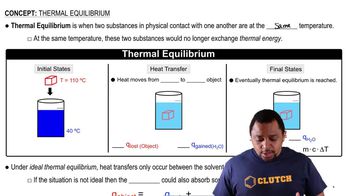
Thermal expansion refers to the increase in volume of a material as its temperature rises. In metals, this occurs because the increased kinetic energy of atoms causes them to vibrate more vigorously, leading to greater distances between them. This phenomenon is typically linear for solids, meaning that as temperature increases, the dimensions of the material, including length, width, and height, expand proportionally.
Video consigliato:
Percorso guidato
02:35
Thermal Equilibrium

Unit Cell Length

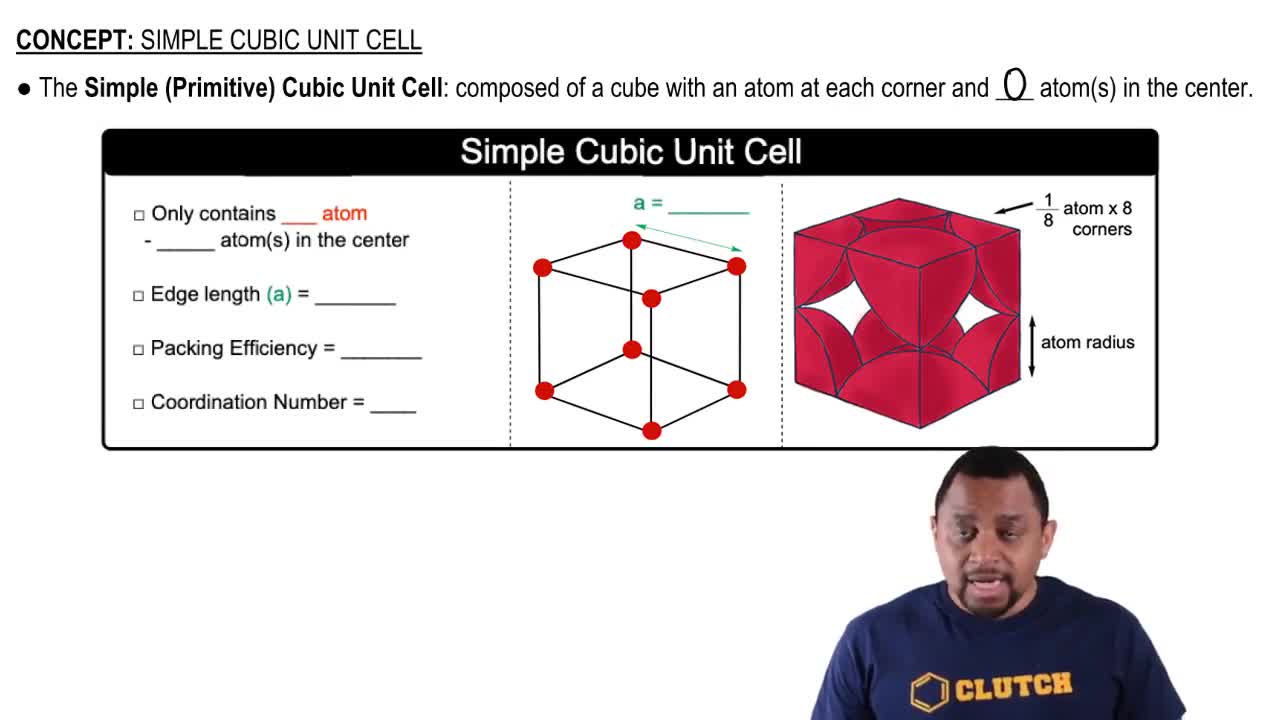
The unit cell is the smallest repeating unit in a crystal lattice that defines the structure of a solid. As temperature increases and thermal expansion occurs, the dimensions of the unit cell also increase, leading to a longer unit cell length. This change can affect the overall properties of the material, including its mechanical and thermal characteristics, as the arrangement of atoms within the unit cell is altered.
Video consigliato:
Percorso guidato
01:27
Simple Cubic Unit Cell

Density

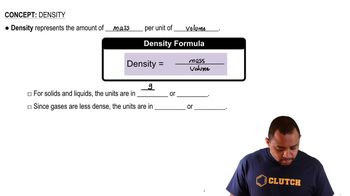
Density is defined as mass per unit volume and is a critical property of materials. When a metal is heated and undergoes thermal expansion, its volume increases while its mass remains constant, leading to a decrease in density. This relationship is important in understanding how temperature changes can affect the buoyancy and structural integrity of metals in various applications.
Video consigliato:
Percorso guidato
01:56
Density Concepts