Ch.12 - Solids and Modern Materials
Brown - Chemistry: The Central Science 14th Edition
Brown14th EditionChemistry: The Central ScienceISBN: 9780134414232Non è quello che usi tu?Cambia libro di testo
Capitolo 12, Problema 76b

Cadmium telluride is an important material for solar cells. (b) What wavelength of light would a photon of this energy correspond to?

Guida verificata passo dopo passo
1
Identify the energy band gap of cadmium telluride, which is typically around 1.5 eV.
Use the energy-wavelength relationship given by the equation: \( E = \frac{hc}{\lambda} \), where \( E \) is the energy, \( h \) is Planck's constant \( (6.626 \times 10^{-34} \text{ J s}) \), \( c \) is the speed of light \( (3.00 \times 10^8 \text{ m/s}) \), and \( \lambda \) is the wavelength.
Convert the energy from electron volts (eV) to joules (J) using the conversion factor \( 1 \text{ eV} = 1.602 \times 10^{-19} \text{ J} \).
Rearrange the equation to solve for wavelength: \( \lambda = \frac{hc}{E} \).
Substitute the values for \( h \), \( c \), and the converted energy \( E \) into the equation to find the wavelength \( \lambda \).

Risposta video verificata per un problema simile:

Questa soluzione video è stata consigliata dai nostri tutor come utile per risolvere questo problema.
Durata del video:
2m

Concetti chiave

Ecco i concetti essenziali che devi comprendere per rispondere correttamente alla domanda.

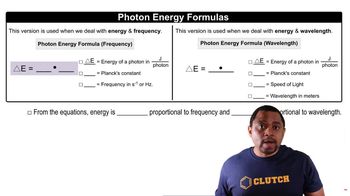
Photon Energy

Photon energy is the energy carried by a single photon, which is directly proportional to its frequency and inversely proportional to its wavelength. The energy of a photon can be calculated using the equation E = hν, where E is energy, h is Planck's constant, and ν is frequency. This relationship is crucial for understanding how different wavelengths of light correspond to different energy levels.
Video consigliato:
Percorso guidato
01:40
Photon Energy Formulas

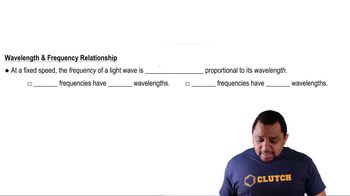
Wavelength and Frequency Relationship

The relationship between wavelength and frequency is described by the equation c = λν, where c is the speed of light, λ is the wavelength, and ν is the frequency. This means that as the wavelength of light increases, its frequency decreases, and vice versa. Understanding this relationship is essential for converting photon energy into the corresponding wavelength of light.
Video consigliato:
Percorso guidato
00:31
Frequency-Wavelength Relationship

Cadmium Telluride in Solar Cells

Cadmium telluride (CdTe) is a semiconductor material commonly used in solar cells due to its suitable bandgap energy, which allows it to efficiently absorb sunlight. The bandgap energy determines the range of photon energies that can be absorbed, influencing the wavelengths of light that can be converted into electrical energy. Knowing the bandgap energy of CdTe helps in calculating the corresponding wavelength of light that can be utilized in solar energy applications.
Video consigliato:
Percorso guidato
02:22
Galvanic Cell Components Example