Ch.12 - Solids and Modern Materials
Brown - Chemistry: The Central Science 14th Edition
Brown14th EditionChemistry: The Central ScienceISBN: 9780134414232Non è quello che usi tu?Cambia libro di testo
Capitolo 12, Problema 14d

Which type (or types) of crystalline solid is characterized by each of the following? (d) network of covalent bonds.

Guida verificata passo dopo passo
1
Identify the key characteristic of the crystalline solid mentioned in the problem, which is a 'network of covalent bonds'.
Understand that a network of covalent bonds in a solid implies that the atoms are bonded in a continuous network across the entire structure, rather than being isolated molecules or ions.
Recall the four main types of crystalline solids: molecular, ionic, metallic, and covalent network.
Analyze which type of crystalline solid typically features a continuous network of covalent bonds. This type of solid is characterized by strong, directional covalent bonds that extend throughout the material, forming a rigid structure.
Conclude that the type of crystalline solid characterized by a network of covalent bonds is known as a 'covalent network solid'.

Risposta video verificata per un problema simile:

Questa soluzione video è stata consigliata dai nostri tutor come utile per risolvere questo problema.
Durata del video:
2m

Concetti chiave

Ecco i concetti essenziali che devi comprendere per rispondere correttamente alla domanda.

Covalent Network Solids

Covalent network solids are a type of crystalline solid where atoms are connected by a continuous network of covalent bonds. This structure results in materials that are typically very hard, have high melting points, and are poor conductors of electricity. Examples include diamond and silicon carbide, which exhibit exceptional strength and stability due to their extensive bonding.
Video consigliato:
Percorso guidato
04:13
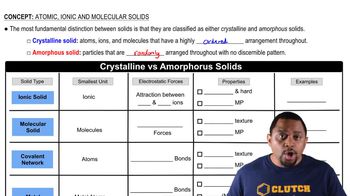
Crystalline vs Amorphous Solids

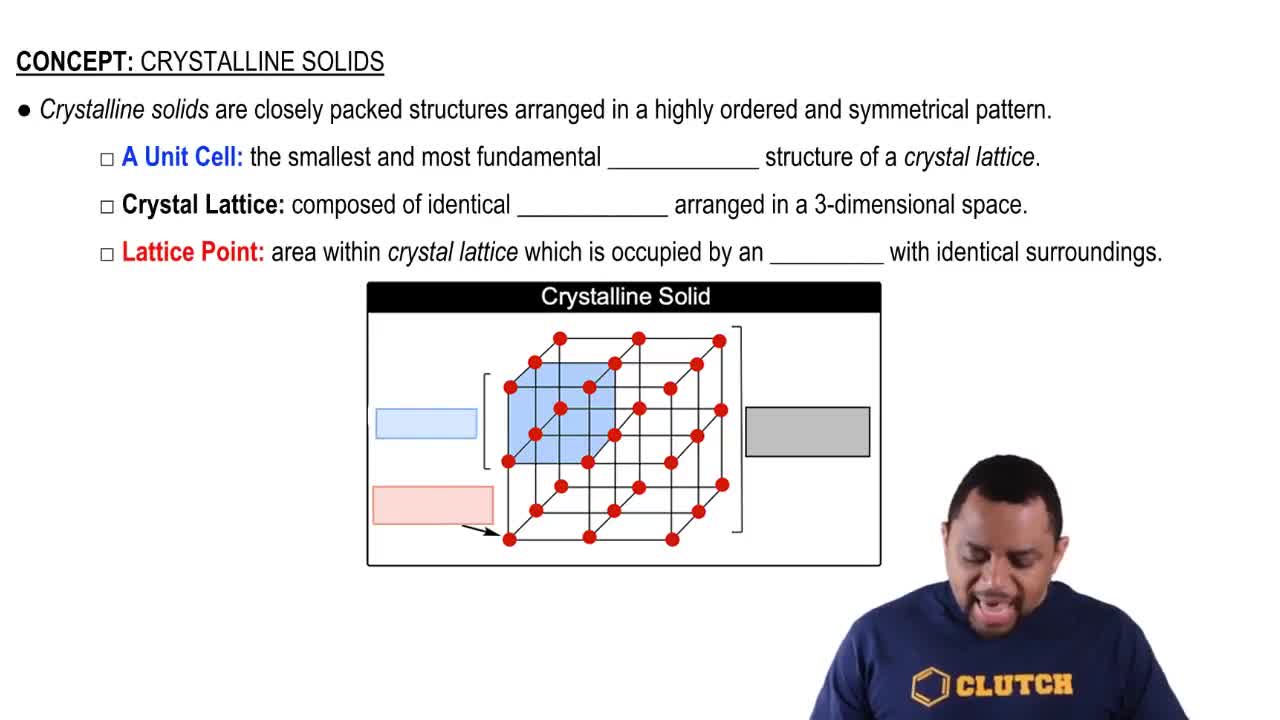
Crystalline Solids

Crystalline solids are materials whose constituents, such as atoms or molecules, are arranged in an orderly repeating pattern extending in all three spatial dimensions. This regular arrangement leads to distinct geometric shapes and well-defined melting points. Crystalline solids can be classified into various types, including ionic, covalent, metallic, and molecular solids, each with unique properties.
Video consigliato:
Percorso guidato
01:31
Crystalline Solids Structure

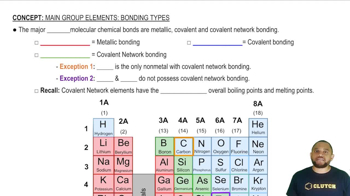
Bonding Types in Solids

The type of bonding in solids significantly influences their physical properties. In covalent network solids, strong covalent bonds create a rigid structure, while ionic solids are held together by electrostatic forces between charged ions. Understanding these bonding types helps predict the behavior of materials under different conditions, such as temperature and pressure, and their suitability for various applications.
Video consigliato: