
Ch.13 - Properties of Solutions
Brown - Chemistry: The Central Science 14th Edition
Brown14th EditionChemistry: The Central ScienceISBN: 9780134414232Non è quello che usi tu?Cambia libro di testo
Capitolo 13, Problema 65

(a) Calculate the vapor pressure of water above a solution prepared by adding 22.5 g of lactose (C12H22O11) to 200.0 g of water at 338 K. (Vapor–pressure data for water are given in Appendix B.)

Guida verificata passo dopo passo
1
Step 1: Determine the molar mass of lactose (C_{12}H_{22}O_{11}) by adding the atomic masses of its constituent elements: 12 carbon atoms, 22 hydrogen atoms, and 11 oxygen atoms.
Step 2: Calculate the number of moles of lactose using the formula: \( \text{moles of lactose} = \frac{\text{mass of lactose}}{\text{molar mass of lactose}} \).
Step 3: Calculate the number of moles of water using its molar mass (approximately 18.02 g/mol) and the given mass of water (200.0 g).
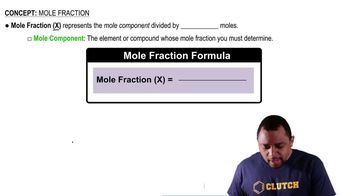
Step 4: Determine the mole fraction of water in the solution using the formula: \( \text{mole fraction of water} = \frac{\text{moles of water}}{\text{moles of water} + \text{moles of lactose}} \).
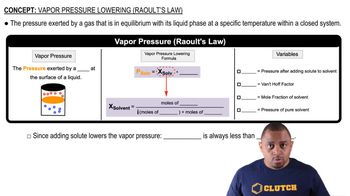
Step 5: Use Raoult's Law to calculate the vapor pressure of water above the solution: \( P_{\text{solution}} = \chi_{\text{water}} \times P^0_{\text{water}} \), where \( P^0_{\text{water}} \) is the vapor pressure of pure water at 338 K.

Concetti chiave

Ecco i concetti essenziali che devi comprendere per rispondere correttamente alla domanda.

Vapor Pressure

Vapor pressure is the pressure exerted by a vapor in equilibrium with its liquid or solid phase at a given temperature. It reflects the tendency of particles to escape from the liquid phase into the vapor phase. The vapor pressure of a solvent decreases when a non-volatile solute, like lactose, is added, due to the solute particles occupying space at the surface and reducing the number of solvent molecules that can escape.
Video consigliato:
Percorso guidato
02:40
Raoult's Law and Vapor Pressure

Raoult's Law

Raoult's Law states that the vapor pressure of a solvent in a solution is directly proportional to the mole fraction of the solvent. This law is crucial for calculating the vapor pressure of a solution, as it allows us to determine how the addition of a solute affects the overall vapor pressure. In this case, the mole fraction of water must be calculated to apply Raoult's Law effectively.
Video consigliato:
Percorso guidato
02:40
Raoult's Law and Vapor Pressure

Mole Fraction

Mole fraction is a way of expressing the concentration of a component in a mixture, defined as the number of moles of that component divided by the total number of moles of all components in the mixture. It is a dimensionless quantity and is essential for applying Raoult's Law, as it helps quantify the proportion of solvent present in the solution after the solute is added.
Video consigliato:
Percorso guidato
00:36
Mole Fraction Formula