Ch.13 - Properties of Solutions
Brown - Chemistry: The Central Science 14th Edition
Brown14th EditionChemistry: The Central ScienceISBN: 9780134414232Non è quello che usi tu?Cambia libro di testo
Capitolo 13, Problema 99

A 'canned heat' product used to warm buffet dishes consists of a homogeneous mixture of ethanol 1C2H5OH2 and paraffin, which has an average formula of C24H50. What mass of C2H5OH should be added to 620 kg of the paraffin to produce 8 torr of ethanol vapor pressure at 35 °C? The vapor pressure of pure ethanol at 35 °C is 100 torr.

Guida verificata passo dopo passo
1
Identify the components of the mixture: ethanol (\(C_2H_5OH\)) and paraffin (\(C_{24}H_{50}\)).
Use Raoult's Law to relate the vapor pressure of the solution to the mole fraction of ethanol: \(P_{solution} = X_{ethanol} \times P^0_{ethanol}\), where \(P_{solution}\) is the vapor pressure of ethanol in the mixture (8 torr), \(X_{ethanol}\) is the mole fraction of ethanol, and \(P^0_{ethanol}\) is the vapor pressure of pure ethanol (100 torr).
Rearrange Raoult's Law to solve for the mole fraction of ethanol: \(X_{ethanol} = \frac{P_{solution}}{P^0_{ethanol}}\).
Calculate the moles of paraffin using its molar mass (\(C_{24}H_{50}\)) and the given mass (620 kg).
Use the mole fraction equation \(X_{ethanol} = \frac{n_{ethanol}}{n_{ethanol} + n_{paraffin}}\) to solve for the moles of ethanol needed, and then convert this to mass using the molar mass of ethanol.

Risposta video verificata per un problema simile:

Questa soluzione video è stata consigliata dai nostri tutor come utile per risolvere questo problema.
Durata del video:
3m

Concetti chiave

Ecco i concetti essenziali che devi comprendere per rispondere correttamente alla domanda.

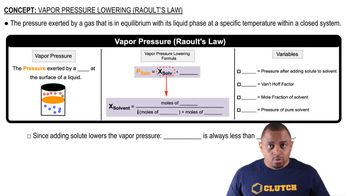
Raoult's Law

Raoult's Law states that the vapor pressure of a solvent in a solution is directly proportional to the mole fraction of the solvent present. In this case, it helps determine how the addition of ethanol affects the overall vapor pressure of the mixture with paraffin. Understanding this law is crucial for calculating the required mass of ethanol to achieve a specific vapor pressure.
Video consigliato:
Percorso guidato
02:40
Raoult's Law and Vapor Pressure

Mole Fraction

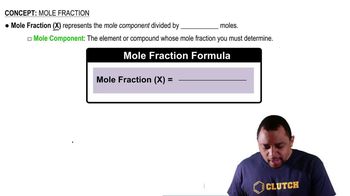
Mole fraction is a way of expressing the concentration of a component in a mixture, defined as the number of moles of that component divided by the total number of moles of all components. In this problem, calculating the mole fraction of ethanol in the mixture is essential to apply Raoult's Law and find the mass of ethanol needed to reach the desired vapor pressure.
Video consigliato:
Percorso guidato
00:36
Mole Fraction Formula

Vapor Pressure

Vapor pressure is the pressure exerted by a vapor in equilibrium with its liquid or solid phase at a given temperature. It is a key concept in understanding how substances behave in mixtures. In this scenario, knowing the vapor pressure of pure ethanol and how it changes when mixed with paraffin is vital for determining how much ethanol is needed to achieve the target vapor pressure of 8 torr.
Video consigliato:
Percorso guidato
02:40
Raoult's Law and Vapor Pressure
Pratica correlata
Domanda del libro di testo

Acetonitrile (CH3CN) is a polar organic solvent that dissolves a wide range of solutes, including many salts. The density of a 1.80 M LiBr solution in acetonitrile is 0.826 g/cm3. Calculate the concentration of the solution in (a) molality,

630
views
Domanda del libro di testo

Acetonitrile (CH3CN) is a polar organic solvent that dissolves a wide range of solutes, including many salts. The density of a 1.80 M LiBr solution in acetonitrile is 0.826 g/cm3. Calculate the concentration of the solution in (b) mole fraction of LiBr,

820
views
Domanda del libro di testo

Two beakers are placed in a sealed box at 25 °C. One beaker contains 30.0 mL of a 0.050 M aqueous solution of a nonvolatile nonelectrolyte. The other beaker contains 30.0 mL of a 0.035 M aqueous solution of NaCl. The water vapor from the two solutions reaches equilibrium. (a) In which beaker does the solution level rise, and in which one does it fall?

580
views
Domanda del libro di testo

Two beakers are placed in a sealed box at 25 °C. One beaker contains 30.0 mL of a 0.050 M aqueous solution of a nonvolatile nonelectrolyte. The other beaker contains 30.0 mL of a 0.035 M aqueous solution of NaCl. The water vapor from the two solutions reaches equilibrium. (b) What are the volumes in the two beakers when equilibrium is attained, assuming ideal behavior?

812
views
Domanda del libro di testo

Acetonitrile (CH3CN) is a polar organic solvent that dissolves a wide range of solutes, including many salts. The density of a 1.80 M LiBr solution in acetonitrile is 0.826 g/cm3. Calculate the concentration of the solution in (c) mass percentage of CH3CN.