Ch.13 - Properties of Solutions
Brown - Chemistry: The Central Science 14th Edition
Brown14th EditionChemistry: The Central ScienceISBN: 9780134414232Non è quello che usi tu?Cambia libro di testo
Capitolo 13, Problema 69

(a) Does a 0.10 m aqueous solution of NaCl have a higher boiling point, a lower boiling point, or the same boiling point as a 0.10 m aqueous solution of C6H12O6?

Guida verificata passo dopo passo
1
Identify the colligative property involved: Boiling point elevation is a colligative property, which means it depends on the number of solute particles in a solution, not their identity.
Determine the van't Hoff factor (i) for each solute: NaCl dissociates into two ions (Na^+ and Cl^-), so i = 2. C6H12O6 (glucose) does not dissociate in solution, so i = 1.
Use the boiling point elevation formula: \( \Delta T_b = i \cdot K_b \cdot m \), where \( \Delta T_b \) is the boiling point elevation, \( K_b \) is the ebullioscopic constant of the solvent, and \( m \) is the molality of the solution.
Compare the boiling point elevations: Since the molality (m) and the solvent (water) are the same for both solutions, the difference in boiling point elevation will depend on the van't Hoff factor (i).
Conclude which solution has a higher boiling point: The solution with the higher van't Hoff factor (NaCl) will have a greater boiling point elevation, thus a higher boiling point than the glucose solution.

Risposta video verificata per un problema simile:

Questa soluzione video è stata consigliata dai nostri tutor come utile per risolvere questo problema.
Durata del video:
1m

Concetti chiave

Ecco i concetti essenziali che devi comprendere per rispondere correttamente alla domanda.

Colligative Properties

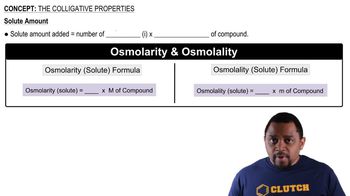
Colligative properties are physical properties of solutions that depend on the number of solute particles in a given amount of solvent, rather than the identity of the solute. These properties include boiling point elevation, freezing point depression, vapor pressure lowering, and osmotic pressure. In this context, the boiling point elevation is particularly relevant, as it indicates how the presence of solute particles affects the boiling point of the solvent.
Video consigliato:
Percorso guidato
01:26
Colligative Properties

Boiling Point Elevation

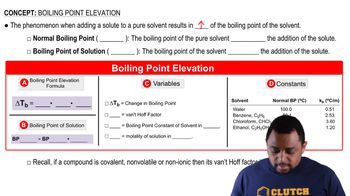
Boiling point elevation occurs when a non-volatile solute is added to a solvent, resulting in an increase in the boiling point of the solution compared to the pure solvent. This phenomenon is quantified by the formula ΔT_b = i * K_b * m, where ΔT_b is the boiling point elevation, i is the van 't Hoff factor (number of particles the solute dissociates into), K_b is the ebullioscopic constant of the solvent, and m is the molality of the solution. The greater the number of solute particles, the higher the boiling point.
Video consigliato:
Percorso guidato
03:05
Boiling Point Elevation

Van 't Hoff Factor (i)

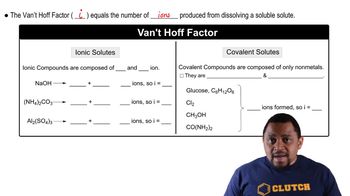
The van 't Hoff factor (i) represents the number of particles into which a solute dissociates in solution. For example, NaCl dissociates into two ions (Na+ and Cl-), giving it an i value of 2, while glucose (C6H12O6) does not dissociate and has an i value of 1. This factor is crucial for calculating colligative properties, as it directly influences the extent of boiling point elevation in solutions.
Video consigliato:
Percorso guidato
02:50
Van't Hoff Factor