Ch.13 - Properties of Solutions
Brown - Chemistry: The Central Science 14th Edition
Brown14th EditionChemistry: The Central ScienceISBN: 9780134414232Non è quello che usi tu?Cambia libro di testo
Capitolo 13, Problema 53d

Describe how you would prepare each of the following aqueous solutions, starting with solid KBr: (d) a 0.150 M solution of KBr that contains just enough KBr to precipitate 16.0 g of AgBr from a solution containing 0.480 mol of AgNO3.

Guida verificata passo dopo passo
1
Calculate the moles of AgBr that can be precipitated using the given mass of AgBr. Use the molar mass of AgBr to convert grams to moles.
Use the stoichiometry of the reaction between KBr and AgNO3 to determine the moles of KBr needed to precipitate the calculated moles of AgBr. The reaction is: KBr + AgNO3 -> AgBr + KNO3.
Calculate the mass of KBr required using its molar mass and the moles of KBr determined in the previous step.
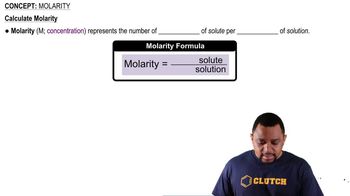
Determine the volume of the 0.150 M KBr solution needed to contain the calculated moles of KBr. Use the formula: Molarity (M) = moles of solute / liters of solution.
Dissolve the calculated mass of KBr in enough water to make the volume of solution determined in the previous step.

Risposta video verificata per un problema simile:

Questa soluzione video è stata consigliata dai nostri tutor come utile per risolvere questo problema.
Durata del video:
3m

Concetti chiave

Ecco i concetti essenziali che devi comprendere per rispondere correttamente alla domanda.

Molarity (M)

Molarity is a measure of concentration defined as the number of moles of solute per liter of solution. It is expressed in moles per liter (mol/L). Understanding molarity is crucial for preparing solutions, as it allows you to calculate the amount of solute needed to achieve a desired concentration in a given volume of solvent.
Video consigliato:
Percorso guidato
00:53
Molarity Concept

Stoichiometry

Stoichiometry involves the calculation of reactants and products in chemical reactions based on balanced equations. In this context, it helps determine the amount of KBr needed to precipitate a specific mass of AgBr from AgNO3. By using the molar ratios from the balanced equation, one can relate the quantities of reactants and products.
Video consigliato:
Percorso guidato
01:16
Stoichiometry Concept

Precipitation Reaction

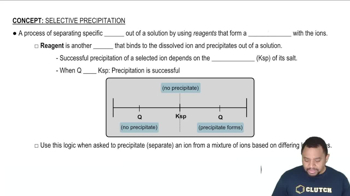
A precipitation reaction occurs when two soluble salts react to form an insoluble product, or precipitate. In this case, KBr reacts with AgNO3 to form AgBr, which is insoluble in water. Understanding this concept is essential for predicting the formation of precipitates and calculating the amounts of reactants required to achieve a desired precipitate mass.
Video consigliato:
Percorso guidato
01:53
Selective Precipitation