
The 'free-base' form of cocaine (C17H21NO4) and its protonated hydrochloride form (C17H21NO4) are shown below; the free-base form can be converted to the hydrochloride form with one equivalent of HCl. For clarity, not all the carbon and hydrogen atoms are shown; each vertex represents a carbon atom with the appropriate number of hydrogen atoms so that each carbon makes four bonds to other atoms (e) How many mL of a concentrated 18.0 M HCl aqueous solution would it take to convert 1.00 kilograms (a 'kilo') of the free-base form of cocaine into its hydrochloride form?
Ch.13 - Properties of Solutions
Brown14th EditionChemistry: The Central ScienceISBN: 9780134414232Non è quello che usi tu?Cambia libro di testo
Capitolo 13, Problema 91a
The 'free-base' form of cocaine (C17H21NO4) and its protonated hydrochloride form (C17H22ClNO4) are shown below; the free-base form can be converted to the hydrochloride form with one equivalent of HCl. For clarity, not all the carbon and hydrogen atoms are shown; each vertex represents a carbon atom with the appropriate number of hydrogen atoms so that each carbon makes four bonds to other atoms
(a) One of these forms of cocaine is relatively water-soluble: which form, the free base or the hydrochloride?
Guida verificata passo dopo passo1
Identify the two forms of cocaine: the free-base form (C_{17}H_{21}NO_{4}) and the hydrochloride form (C_{17}H_{22}ClNO_{4}).
Understand that solubility in water is influenced by the polarity of the molecule. Polar molecules are generally more soluble in water.
Recognize that the hydrochloride form of cocaine is a salt, which typically increases its polarity and, consequently, its solubility in water.
Consider the role of the hydrochloride group (Cl^-) in the hydrochloride form, which can form ionic interactions with water, enhancing solubility.
Conclude that the hydrochloride form of cocaine is more water-soluble than the free-base form due to its ionic nature and increased polarity.

Risposta video verificata per un problema simile:
Questa soluzione video è stata consigliata dai nostri tutor come utile per risolvere questo problema.
Durata del video:
3mConcetti chiave
Ecco i concetti essenziali che devi comprendere per rispondere correttamente alla domanda.
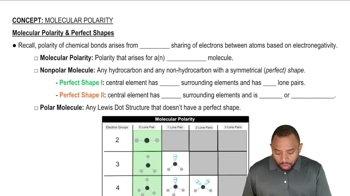
Solubility and Polarity
Solubility refers to the ability of a substance to dissolve in a solvent, which is often influenced by the polarity of the molecules involved. Polar substances tend to dissolve well in polar solvents (like water), while nonpolar substances are more soluble in nonpolar solvents. The presence of functional groups, such as -Cl in hydrochloride, can increase polarity and thus enhance water solubility.
Video consigliato:
Percorso guidato
Molecular Polarity
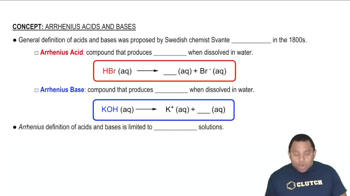
Acid-Base Chemistry
Acid-base chemistry involves the transfer of protons (H+) between substances. In this context, the free-base form of cocaine can accept a proton from HCl to form the hydrochloride salt. This protonation alters the molecule's properties, including its solubility, as the resulting salt is typically more soluble in water due to increased ionic character.
Video consigliato:
Percorso guidato
Arrhenius Acids and Bases
Ionic vs. Molecular Compounds
Ionic compounds, such as hydrochloride salts, are formed from the electrostatic attraction between positively and negatively charged ions. These compounds generally have higher solubility in water compared to molecular compounds, like the free base form, which are held together by covalent bonds. The ionic nature of hydrochloride enhances its interaction with water molecules, leading to greater solubility.
Video consigliato:
Percorso guidato
Ionic Compounds Naming
Pratica correlata
Domanda del libro di testo
1668
views
Domanda del libro di testo
Aerosols are important components of the atmosphere. Does the presence of aerosols in the atmosphere increase or decrease the amount of sunlight that arrives at the Earth's surface, compared to an 'aerosol-free' atmosphere? Explain your reasoning.
507
views
Domanda del libro di testo
A supersaturated solution of sucrose (C12H22O11) is made by dissolving sucrose in hot water and slowly letting the solution cool to room temperature. After a long time, the excess sucrose crystallizes out of the solution. Indicate whether each of the following statements is true or false: (b) After the excess sucrose has crystallized out, the system is now unstable and is not in equilibrium.
1355
views
