Ch.13 - Properties of Solutions
Brown - Chemistry: The Central Science 14th Edition
Brown14th EditionChemistry: The Central ScienceISBN: 9780134414232Non è quello che usi tu?Cambia libro di testo
Capitolo 13, Problema 36

Indicate whether each statement is true or false: (c) The solubility of most gases in water decreases as the temperature increases because water is breaking its hydrogen bonding to the gas molecules as the temperature is raised.

Guida verificata passo dopo passo
1
Understand the relationship between gas solubility and temperature: Generally, the solubility of gases in liquids decreases with an increase in temperature.
Consider the kinetic energy of gas molecules: As temperature increases, the kinetic energy of gas molecules also increases, making them more likely to escape from the liquid into the gas phase.
Examine the role of hydrogen bonding: While water does form hydrogen bonds, the decrease in gas solubility with increasing temperature is primarily due to increased kinetic energy, not the breaking of hydrogen bonds.
Evaluate the statement: The statement suggests that the decrease in solubility is due to water breaking its hydrogen bonds with gas molecules, which is not the primary reason for decreased solubility.
Conclude the evaluation: Based on the understanding of gas solubility and temperature, the statement is false because the decrease in solubility is mainly due to increased kinetic energy, not the breaking of hydrogen bonds.

Risposta video verificata per un problema simile:

Questa soluzione video è stata consigliata dai nostri tutor come utile per risolvere questo problema.
Durata del video:
1m

Concetti chiave

Ecco i concetti essenziali che devi comprendere per rispondere correttamente alla domanda.

Gas Solubility in Liquids

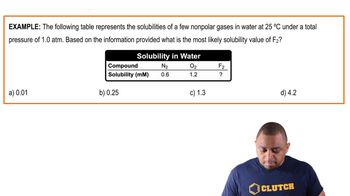
The solubility of gases in liquids is influenced by temperature and pressure. Generally, as temperature increases, the kinetic energy of gas molecules also increases, leading to a decrease in solubility. This is because gas molecules are more likely to escape from the liquid phase into the gas phase at higher temperatures.
Video consigliato:
Percorso guidato
01:44
Gas Solubility Example

Hydrogen Bonding

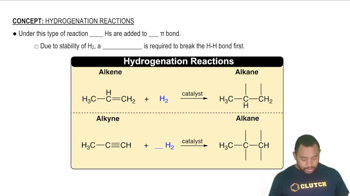
Hydrogen bonding is a type of intermolecular force that occurs when hydrogen is covalently bonded to highly electronegative atoms like oxygen or nitrogen. In the context of water, these bonds create a structured network that can affect how gases interact with water. However, the statement incorrectly attributes the decrease in gas solubility to the breaking of hydrogen bonds with gas molecules.
Video consigliato:
Percorso guidato
01:22
Hydrogenation Reactions

Henry's Law

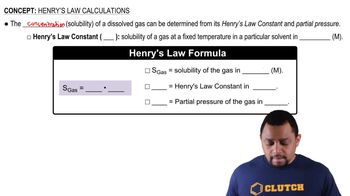
Henry's Law states that the amount of gas that dissolves in a liquid at a given temperature is directly proportional to the partial pressure of that gas above the liquid. This principle helps explain why gas solubility decreases with increasing temperature, as higher temperatures reduce the gas's tendency to remain dissolved, regardless of the interactions with water molecules.
Video consigliato:
Percorso guidato
01:40
Henry's Law Calculations