Ch.13 - Properties of Solutions
Brown - Chemistry: The Central Science 14th Edition
Brown14th EditionChemistry: The Central ScienceISBN: 9780134414232Non è quello che usi tu?Cambia libro di testo
Capitolo 13, Problema 93b

Most fish need at least 4 ppm dissolved O2 in water for survival. (b) What partial pressure of O2 above water is needed to obtain 4 ppm O2 in water at 10 °C? (The Henry's law constant for O2 at this temperature is 1.71⨉10-3 mol/L-atm.)

Guida verificata passo dopo passo
1
Understand that ppm (parts per million) is a way to express concentration. For gases dissolved in water, 4 ppm means 4 mg of O_2 per liter of water.
Convert the concentration from ppm to molarity (mol/L). Use the molar mass of O_2, which is approximately 32.00 g/mol, to convert mg/L to mol/L.
Apply Henry's Law, which states that the concentration of a gas in a liquid is directly proportional to the partial pressure of the gas above the liquid. The formula is C = kP, where C is the concentration of the gas, k is the Henry's law constant, and P is the partial pressure.
Rearrange the formula to solve for the partial pressure: P = C/k.
Substitute the values for C (from step 2) and k (given as 1.71⨉10^-3 mol/L-atm) into the equation to find the partial pressure of O_2 needed.

Risposta video verificata per un problema simile:

Questa soluzione video è stata consigliata dai nostri tutor come utile per risolvere questo problema.
Durata del video:
3m

Concetti chiave

Ecco i concetti essenziali che devi comprendere per rispondere correttamente alla domanda.

Henry's Law

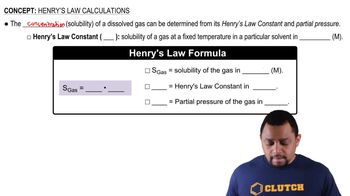
Henry's Law states that the amount of a gas that dissolves in a liquid at a given temperature is directly proportional to the partial pressure of that gas above the liquid. This relationship can be expressed mathematically as C = kH * P, where C is the concentration of the gas in the liquid, kH is the Henry's law constant, and P is the partial pressure of the gas.
Video consigliato:
Percorso guidato
01:40
Henry's Law Calculations

Dissolved Oxygen Concentration

Dissolved oxygen concentration refers to the amount of oxygen that is present in water, typically measured in parts per million (ppm) or milligrams per liter (mg/L). For aquatic life, maintaining a certain level of dissolved oxygen is crucial for survival, as it is essential for respiration in fish and other organisms.
Video consigliato:
Percorso guidato
07:35
Calculate Concentration of the Basic Form

Temperature Effects on Gas Solubility

The solubility of gases in liquids is influenced by temperature; generally, as temperature increases, the solubility of gases decreases. This is important in aquatic environments, as warmer water holds less dissolved oxygen, which can affect fish survival and ecosystem health.
Video consigliato:
Percorso guidato
01:44
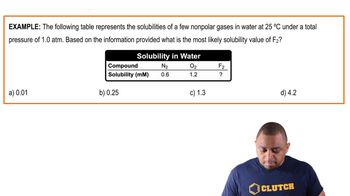
Gas Solubility Example