
Ch.13 - Properties of Solutions
Brown - Chemistry: The Central Science 14th Edition
Brown14th EditionChemistry: The Central ScienceISBN: 9780134414232Non è quello che usi tu?Cambia libro di testo
Capitolo 13, Problema 50a

The density of toluene (C7H8) is 0.867 g/mL, and the density of thiophene (C4H4S) is 1.065 g/mL. A solution is made by dissolving 8.10 g of thiophene in 250.0 mL of toluene. (a) Calculate the mole fraction of thiophene in the solution.

Guida verificata passo dopo passo
1
Step 1: Calculate the number of moles of each component. The number of moles is given by the formula: n = mass / molar mass. The molar mass of thiophene (C4H4S) is approximately 84.14 g/mol and the molar mass of toluene (C7H8) is approximately 92.14 g/mol.
Step 2: Use the given mass of thiophene (8.10 g) and the molar mass from step 1 to calculate the number of moles of thiophene.
Step 3: Use the given volume of toluene (250.0 mL), the density of toluene (0.867 g/mL), and the molar mass from step 1 to calculate the number of moles of toluene.
Step 4: The mole fraction of a component in a solution is given by the formula: X = n_component / n_total. Calculate the total number of moles (n_total) by adding the number of moles of thiophene and toluene.
Step 5: Substitute the number of moles of thiophene and the total number of moles into the formula from step 4 to calculate the mole fraction of thiophene in the solution.

Risposta video verificata per un problema simile:

Questa soluzione video è stata consigliata dai nostri tutor come utile per risolvere questo problema.
Durata del video:
4m

Concetti chiave

Ecco i concetti essenziali che devi comprendere per rispondere correttamente alla domanda.

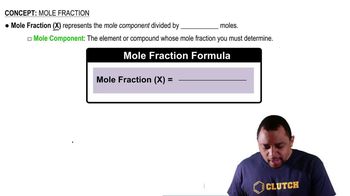
Mole Fraction

Mole fraction is a way of expressing the concentration of a component in a mixture. It is defined as the ratio of the number of moles of a specific component to the total number of moles of all components in the mixture. This concept is crucial for understanding the composition of solutions and is often used in calculations involving colligative properties.
Video consigliato:
Percorso guidato
00:36
Mole Fraction Formula

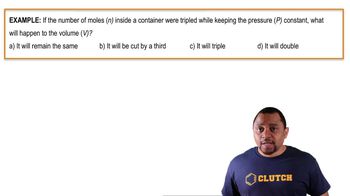
Density and Volume Relationship

Density is defined as mass per unit volume and is a key property of substances. In this context, knowing the density of toluene allows us to convert the volume of toluene (250.0 mL) into mass, which is necessary for calculating the total number of moles in the solution. Understanding this relationship is essential for solving problems involving solutions and mixtures.
Video consigliato:
Percorso guidato
01:09
Relationship of Volume and Moles Example

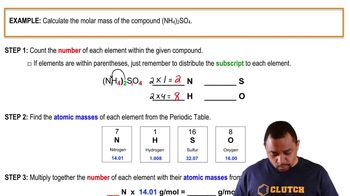
Molar Mass Calculation

Molar mass is the mass of one mole of a substance, typically expressed in grams per mole (g/mol). To calculate the mole fraction of thiophene, we need to determine the number of moles of thiophene and toluene. This requires knowing the molar masses of both compounds, which can be calculated from their chemical formulas by summing the atomic masses of their constituent elements.
Video consigliato:
Percorso guidato
03:12
Molar Mass Calculation Example