
Ch.13 - Properties of Solutions
Brown - Chemistry: The Central Science 14th Edition
Brown14th EditionChemistry: The Central ScienceISBN: 9780134414232Non è quello che usi tu?Cambia libro di testo
Capitolo 13, Problema 83

The osmotic pressure of a 0.010 M aqueous solution of CaCl2 is found to be 0.674 atm at 25 °C. Calculate the van't Hoff factor, i, for the solution.

Guida verificata passo dopo passo
1
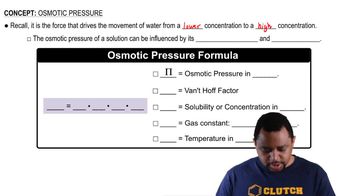
Identify the formula for osmotic pressure: \( \Pi = iMRT \), where \( \Pi \) is the osmotic pressure, \( i \) is the van't Hoff factor, \( M \) is the molarity, \( R \) is the ideal gas constant, and \( T \) is the temperature in Kelvin.
Convert the temperature from Celsius to Kelvin: \( T = 25 + 273.15 \).
Use the given values: \( \Pi = 0.674 \) atm, \( M = 0.010 \) M, \( R = 0.0821 \) L·atm/mol·K, and the converted temperature \( T \).
Rearrange the formula to solve for the van't Hoff factor \( i \): \( i = \frac{\Pi}{MRT} \).
Substitute the known values into the rearranged formula to calculate \( i \).

Risposta video verificata per un problema simile:

Questa soluzione video è stata consigliata dai nostri tutor come utile per risolvere questo problema.
Durata del video:
3m

Concetti chiave

Ecco i concetti essenziali che devi comprendere per rispondere correttamente alla domanda.

Osmotic Pressure

Osmotic pressure is the pressure required to prevent the flow of solvent into a solution through a semipermeable membrane. It is directly proportional to the concentration of solute particles in the solution and can be calculated using the formula π = iCRT, where π is the osmotic pressure, i is the van't Hoff factor, C is the molarity of the solution, R is the ideal gas constant, and T is the temperature in Kelvin.
Video consigliato:
Percorso guidato
01:13
Osmotic Pressure Formula

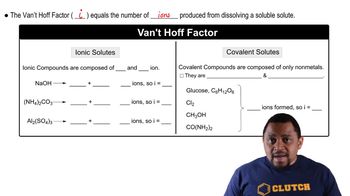
van't Hoff Factor (i)

The van't Hoff factor, denoted as i, represents the number of particles into which a solute dissociates in solution. For ionic compounds, i is greater than 1, as they separate into multiple ions. For example, CaCl2 dissociates into one calcium ion (Ca²⁺) and two chloride ions (Cl⁻), resulting in a van't Hoff factor of 3. This factor is crucial for calculating colligative properties like osmotic pressure.
Video consigliato:
Percorso guidato
02:50
Van't Hoff Factor

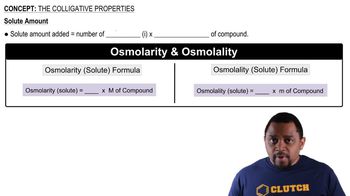
Colligative Properties

Colligative properties are properties of solutions that depend on the number of solute particles rather than their identity. These properties include boiling point elevation, freezing point depression, vapor pressure lowering, and osmotic pressure. Understanding colligative properties is essential for predicting how solute concentration affects the physical behavior of solutions, particularly in the context of osmotic pressure calculations.
Video consigliato:
Percorso guidato
01:26
Colligative Properties