
Ch.14 - Chemical Kinetics
Brown - Chemistry: The Central Science 14th Edition
Brown14th EditionChemistry: The Central ScienceISBN: 9780134414232Non è quello che usi tu?Cambia libro di testo
Capitolo 14, Problema 51b

(b) Does the rate constant for a reaction generally increase or decrease with an increase in reaction temperature?

Guida verificata passo dopo passo
1
Understand the relationship between temperature and reaction rate: The rate of a chemical reaction typically depends on the temperature at which the reaction is carried out.
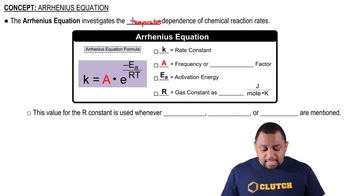
Recall the Arrhenius Equation: This equation, given by \( k = A e^{-\frac{E_a}{RT}} \), where \( k \) is the rate constant, \( A \) is the frequency factor, \( E_a \) is the activation energy, \( R \) is the gas constant, and \( T \) is the temperature in Kelvin, describes how the rate constant changes with temperature.
Analyze the effect of increasing temperature: Increasing the temperature \( T \) in the Arrhenius equation results in a decrease in the value of the exponent \( -\frac{E_a}{RT} \), making the entire exponent larger (less negative).
Examine the exponential term: As the exponent becomes larger, the value of \( e^{-\frac{E_a}{RT}} \) increases because the negative exponent becomes less negative.
Conclude the effect on rate constant: Since the exponential term increases with an increase in temperature, the rate constant \( k \) also increases.

Risposta video verificata per un problema simile:

Questa soluzione video è stata consigliata dai nostri tutor come utile per risolvere questo problema.
Durata del video:
1m

Concetti chiave

Ecco i concetti essenziali che devi comprendere per rispondere correttamente alla domanda.

Rate Constant

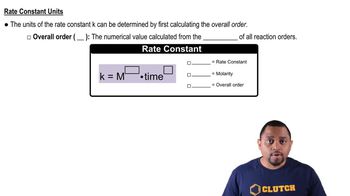
The rate constant (k) is a proportionality factor in the rate equation of a chemical reaction, indicating the speed at which the reaction occurs. It is specific to a particular reaction at a given temperature and is influenced by factors such as temperature, concentration, and the presence of catalysts.
Video consigliato:
Percorso guidato
00:45
Rate Constant Units

Arrhenius Equation

The Arrhenius equation describes how the rate constant of a reaction changes with temperature. It is expressed as k = A * e^(-Ea/RT), where A is the pre-exponential factor, Ea is the activation energy, R is the gas constant, and T is the temperature in Kelvin. This equation shows that an increase in temperature generally leads to an increase in the rate constant.
Video consigliato:
Percorso guidato
01:20
Arrhenius Equation

Activation Energy

Activation energy (Ea) is the minimum energy required for reactants to undergo a chemical reaction. Higher temperatures provide more kinetic energy to the molecules, increasing the likelihood that they will overcome the activation energy barrier, thus enhancing the reaction rate and increasing the rate constant.
Video consigliato:
Percorso guidato
02:02
Activity Series Chart