Ch.14 - Chemical Kinetics
Brown - Chemistry: The Central Science 14th Edition
Brown14th EditionChemistry: The Central ScienceISBN: 9780134414232Non è quello che usi tu?Cambia libro di testo
Capitolo 14, Problema 31

Consider the following reaction: CH3Br(aq) + OH-(aq) → CH3OH(aq) + Br-(aq). The rate law for this reaction is first order in CH3Br and first order in OH-. When [CH3Br] is 5.0 * 10^-3 M and [OH-] is 0.050 M, the reaction rate at 298 K is 0.0432 M/s. (c) What would happen to the rate if the concentration of OH- were tripled? (d) What would happen to the rate if the concentration of both reactants were tripled?

Guida verificata passo dopo passo
1
Identify the rate law for the reaction: The rate law is given as rate = k[CH3Br][OH^-], where k is the rate constant.
Determine the effect of tripling [OH^-]: Since the reaction is first order in OH^-, tripling [OH^-] will triple the rate of the reaction.
Calculate the new rate with tripled [OH^-]: Substitute the new concentration of OH^- (3 * 0.050 M) into the rate law to find the new rate.
Determine the effect of tripling both [CH3Br] and [OH^-]: Since the reaction is first order in both reactants, tripling both will increase the rate by a factor of 3 * 3 = 9.
Calculate the new rate with tripled [CH3Br] and [OH^-]: Substitute the new concentrations of both reactants (3 * 5.0 * 10^-3 M and 3 * 0.050 M) into the rate law to find the new rate.

Concetti chiave

Ecco i concetti essenziali che devi comprendere per rispondere correttamente alla domanda.

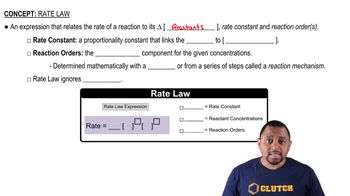
Rate Law

The rate law of a chemical reaction expresses the relationship between the reaction rate and the concentrations of the reactants. It is typically formulated as rate = k[A]^m[B]^n, where k is the rate constant, A and B are the reactants, and m and n are their respective orders. In this case, the reaction is first order in both CH3Br and OH-, indicating that the rate is directly proportional to the concentration of each reactant.
Video consigliato:
Percorso guidato
01:52
Rate Law Fundamentals

Order of Reaction

The order of a reaction refers to the power to which the concentration of a reactant is raised in the rate law. A first-order reaction means that a change in the concentration of that reactant will result in a proportional change in the reaction rate. For the given reaction, since both reactants are first order, tripling the concentration of OH- will directly triple the rate, while tripling both reactants will increase the rate by a factor of nine.
Video consigliato:
Percorso guidato
00:36
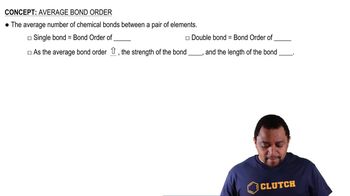
Average Bond Order

Concentration and Reaction Rate

The concentration of reactants plays a crucial role in determining the rate of a chemical reaction. According to the rate law, increasing the concentration of reactants generally leads to an increase in the reaction rate. In this scenario, if the concentration of OH- is tripled, the rate will increase proportionally due to its first-order dependence, while tripling both reactants will result in a more significant increase in the rate due to the multiplicative effect of their concentrations.
Video consigliato:
Percorso guidato
02:03
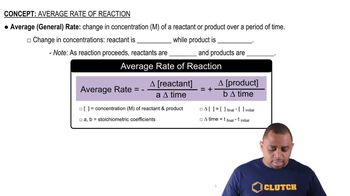
Average Rate of Reaction
Pratica correlata
Domanda del libro di testo

Consider the following reaction: 2 NO1g2 + 2 H21g2¡N21g2 + 2 H2O1g2 (d) What is the reaction rate at 1000 K if [NO] is decreased to 0.010 M and 3H24 is increased to 0.030 M?

437
views

Domanda del libro di testo

The reaction between ethyl bromide (C2H5Br) and hydroxide ion in ethyl alcohol at 330 K, C2H5Br(alc) + OH-(alc) → C2H5OH(l) + Br-(alc), is first order each in ethyl bromide and hydroxide ion. When [C2H5Br] is 0.0477 M and [OH-] is 0.100 M, the rate of disappearance of ethyl bromide is 1.7×10⁻⁷ M/s. (b) What are the units of the rate constant?

Domanda del libro di testo

The decomposition reaction of N2O5 in carbon tetrachloride is 2 N2O5 → 4 NO2 + O2. The rate law is first order in N2O5. At 64°C the rate constant is 4.82 × 10⁻³ s-1. (c) What happens to the rate when the concentration of N2O5 is doubled to 0.0480 M? (d) What happens to the rate when the concentration of N2O5 is halved to 0.0120 M?

Domanda del libro di testo

The reaction between ethyl bromide (C2H5Br) and hydroxide ion in ethyl alcohol at 330 K, C2H5Br(alc) + OH-(alc) → C2H5OH(l) + Br-(alc), is first order each in ethyl bromide and hydroxide ion. When [C2H5Br] is 0.0477 M and [OH-] is 0.100 M, the rate of disappearance of ethyl bromide is 1.7×10⁻⁷ M/s. (c) How would the rate of disappearance of ethyl bromide change if the solution were diluted by adding an equal volume of pure ethyl alcohol to the solution?

560
views
1
rank
Domanda del libro di testo

The reaction between ethyl bromide (C2H5Br) and hydroxide ion in ethyl alcohol at 330 K, C2H5Br(alc) + OH-(alc) → C2H5OH(l) + Br-(alc), is first order each in ethyl bromide and hydroxide ion. When [C2H5Br] is 0.0477 M and [OH-] is 0.100 M, the rate of disappearance of ethyl bromide is 1.7×10⁻⁷ M/s. (a) What is the value of the rate constant?

412
views
Domanda del libro di testo

Consider the following reaction:

2 NO(g) + 2 H2(g) → N2(g) + 2 H2O(g)

(b) If the rate constant for this reaction at 1000 K is 6.0 × 10⁴ M-2 s-1, what is the reaction rate when [NO] = 0.035 M and [H2] = 0.015 M?

(c) What is the reaction rate at 1000 K when the concentration of NO is increased to 0.10 M, while the concentration of H2 is 0.010 M?