Ch.14 - Chemical Kinetics
Brown - Chemistry: The Central Science 14th Edition
Brown14th EditionChemistry: The Central ScienceISBN: 9780134414232Non è quello che usi tu?Cambia libro di testo
Capitolo 14, Problema 96

Consider two reactions. Reaction (1) has a constant halflife, whereas reaction (2) has a half-life that gets longer as the reaction proceeds. What can you conclude about the rate laws of these reactions from these observations?

Guida verificata passo dopo passo
1
Step 1: Understand the concept of half-life. The half-life of a reaction is the time it takes for the concentration of a reactant to decrease by half. It is a measure of how quickly a reaction proceeds.
Step 2: For reaction (1), the half-life is constant. This means that the time it takes for the reactant to decrease by half is the same no matter how much reactant is left. This is characteristic of a first-order reaction, where the rate of the reaction is directly proportional to the concentration of one reactant.
Step 3: For reaction (2), the half-life gets longer as the reaction proceeds. This means that the time it takes for the reactant to decrease by half increases as the reaction continues. This is characteristic of a zero-order reaction, where the rate of the reaction is independent of the concentration of the reactants.
Step 4: Therefore, from these observations, we can conclude that reaction (1) follows a first-order rate law, while reaction (2) follows a zero-order rate law.
Step 5: Remember that the order of a reaction is determined experimentally and it tells us how the rate of a reaction changes as the concentrations of the reactants change. It is an important concept in chemical kinetics.

Risposta video verificata per un problema simile:

Questa soluzione video è stata consigliata dai nostri tutor come utile per risolvere questo problema.
Durata del video:
4m

Concetti chiave

Ecco i concetti essenziali che devi comprendere per rispondere correttamente alla domanda.

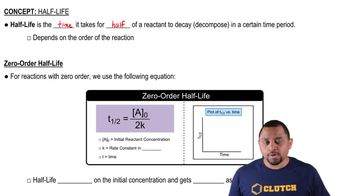
Half-life

Half-life is the time required for the concentration of a reactant to decrease to half of its initial value. In first-order reactions, the half-life is constant and independent of the concentration, while in second-order reactions, the half-life increases as the reaction progresses, indicating a dependence on reactant concentration.
Video consigliato:
Percorso guidato
02:17
Zero-Order Half-life

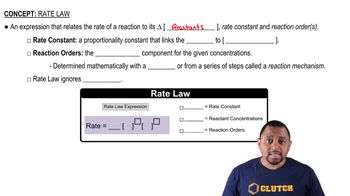
Rate Law

The rate law of a reaction expresses the relationship between the rate of the reaction and the concentration of its reactants. It is determined experimentally and can indicate the order of the reaction, which affects how the rate changes as reactants are consumed. A constant half-life suggests a first-order reaction, while a changing half-life indicates a second-order or higher reaction.
Video consigliato:
Percorso guidato
01:52
Rate Law Fundamentals

Reaction Order

Reaction order refers to the power to which the concentration of a reactant is raised in the rate law. It provides insight into the mechanism of the reaction. A first-order reaction has a linear relationship between concentration and rate, while a second-order reaction shows a quadratic relationship, leading to a longer half-life as reactants are consumed.
Video consigliato:
Percorso guidato
00:36
Average Bond Order