
Ch.14 - Chemical Kinetics
Brown - Chemistry: The Central Science 14th Edition
Brown14th EditionChemistry: The Central ScienceISBN: 9780134414232Non è quello che usi tu?Cambia libro di testo
Capitolo 14, Problema 7b

Given the following diagrams at t = 0 min and t = 30 min
Two diagrams showing reactant concentration at t=0 min (red) and t=20 min (red and blue) for chemical kinetics.
After four half-life periods for a first-order reaction, what fraction of reactant remains? [Section 14.4]

Guida verificata passo dopo passo
1
Identify that the problem involves a first-order reaction and the concept of half-life.
Recall that for a first-order reaction, the half-life (t_1/2) is the time required for the concentration of the reactant to decrease by half.
Understand that after one half-life, the concentration of the reactant is reduced to 1/2 of its initial value.
After two half-lives, the concentration is reduced to (1/2)^2 = 1/4 of its initial value.
After four half-lives, the concentration is reduced to (1/2)^4 = 1/16 of its initial value.

Risposta video verificata per un problema simile:

Questa soluzione video è stata consigliata dai nostri tutor come utile per risolvere questo problema.
Durata del video:
58s

Concetti chiave

Ecco i concetti essenziali che devi comprendere per rispondere correttamente alla domanda.

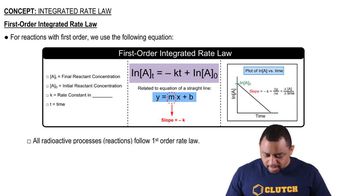
First-Order Reaction

A first-order reaction is a type of chemical reaction where the rate is directly proportional to the concentration of one reactant. This means that as the concentration of the reactant decreases, the rate of the reaction also decreases. The mathematical representation of a first-order reaction is given by the equation: rate = k[A], where k is the rate constant and [A] is the concentration of the reactant.
Video consigliato:
Percorso guidato
02:29
First-Order Reactions

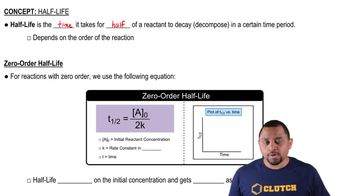
Half-Life

The half-life of a reaction is the time required for the concentration of a reactant to decrease to half of its initial value. For first-order reactions, the half-life is constant and does not depend on the initial concentration. This property allows for easy calculations of remaining reactant concentration over multiple half-lives, making it a crucial concept in kinetics.
Video consigliato:
Percorso guidato
02:17
Zero-Order Half-life

Fraction of Reactant Remaining

The fraction of reactant remaining after a certain number of half-lives can be calculated using the formula: (1/2)^n, where n is the number of half-lives that have passed. For example, after four half-lives, the fraction remaining would be (1/2)^4 = 1/16. This concept is essential for understanding how reactant concentrations change over time in a first-order reaction.
Video consigliato:
Percorso guidato
00:36
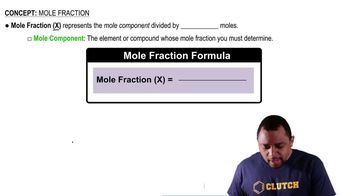
Mole Fraction Formula