Ch.14 - Chemical Kinetics
Brown - Chemistry: The Central Science 14th Edition
Brown14th EditionChemistry: The Central ScienceISBN: 9780134414232Non è quello che usi tu?Cambia libro di testo
Capitolo 14, Problema 87b

The activation energy of an uncatalyzed reaction is 95 kJ/mol. The addition of a catalyst lowers the activation energy to 55 kJ/mol. Assuming that the collision factor remains the same, by what factor will the catalyst increase the rate of the reaction at (b) 125 °C?

Guida verificata passo dopo passo
1
Convert the temperature from Celsius to Kelvin by adding 273.15 to the given temperature.
Use the Arrhenius equation: k = A * e^(-Ea/RT), where k is the rate constant, A is the collision factor, Ea is the activation energy, R is the gas constant (8.314 J/mol·K), and T is the temperature in Kelvin.
Calculate the rate constant for the uncatalyzed reaction using the activation energy of 95 kJ/mol.
Calculate the rate constant for the catalyzed reaction using the activation energy of 55 kJ/mol.
Determine the factor by which the catalyst increases the rate by dividing the rate constant of the catalyzed reaction by the rate constant of the uncatalyzed reaction.

Risposta video verificata per un problema simile:

Questa soluzione video è stata consigliata dai nostri tutor come utile per risolvere questo problema.
Durata del video:
7m

Concetti chiave

Ecco i concetti essenziali che devi comprendere per rispondere correttamente alla domanda.

Activation Energy

Activation energy is the minimum energy required for a chemical reaction to occur. It represents the energy barrier that reactants must overcome to form products. A higher activation energy means that fewer molecules have sufficient energy to react, resulting in a slower reaction rate. Conversely, lowering the activation energy, such as through the use of a catalyst, increases the likelihood of successful collisions between reactant molecules.
Video consigliato:
Percorso guidato
02:02
Activity Series Chart

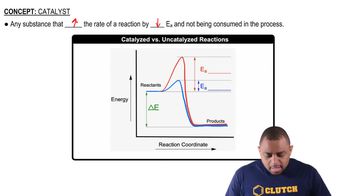
Catalysts

Catalysts are substances that increase the rate of a chemical reaction without being consumed in the process. They work by providing an alternative reaction pathway with a lower activation energy. This allows more reactant molecules to have enough energy to collide and react, thereby speeding up the reaction. Importantly, catalysts do not alter the equilibrium position of a reaction; they only affect the rate at which equilibrium is reached.
Video consigliato:
Percorso guidato
01:59
Catalyzed vs. Uncatalyzed Reactions

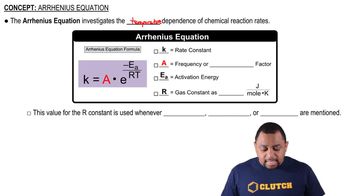
Arrhenius Equation

The Arrhenius equation describes how the rate constant of a reaction depends on temperature and activation energy. It is expressed as k = A * e^(-Ea/RT), where k is the rate constant, A is the pre-exponential factor, Ea is the activation energy, R is the gas constant, and T is the temperature in Kelvin. This equation illustrates that as the activation energy decreases or the temperature increases, the rate constant increases, leading to a faster reaction rate.
Video consigliato:
Percorso guidato
01:20
Arrhenius Equation
Pratica correlata
Domanda del libro di testo

Consider the reaction A + B → C + D. Is each of the following statements true or false? (b) If the reaction is an elementary reaction, the rate law is second order.

374
views
Domanda del libro di testo

The activation energy of an uncatalyzed reaction is 95 kJ/mol. The addition of a catalyst lowers the activation energy to 55 kJ/mol. Assuming that the collision factor remains the same, by what factor will the catalyst increase the rate of the reaction at (a) 25 C

4097
views
1
rank
Domanda del libro di testo

The enzyme urease catalyzes the reaction of urea, (NH2CONH2), with water to produce carbon dioxide and ammonia. In water, without the enzyme, the reaction proceeds with a first-order rate constant of 4.15 × 10⁻⁵ s-1 at 100°C. In the presence of the enzyme in water, the reaction proceeds with a rate constant of 3.4 × 10⁴ s-1 at 21°C. (c) In actuality, what would you expect for the rate of the catalyzed reaction at 100°C as compared to that at 21°C?

2129
views
Domanda del libro di testo

The enzyme urease catalyzes the reaction of urea, (NH2CONH2), with water to produce carbon dioxide and ammonia. In water, without the enzyme, the reaction proceeds with a first-order rate constant of 4.15 × 10⁻⁵ s-1 at 100°C. In the presence of the enzyme in water, the reaction proceeds with a rate constant of 3.4 × 10⁴ s-1 at 21°C. (b) If the rate of the catalyzed reaction were the same at 100°C as it is at 21°C, what would be the difference in the activation energy between the catalyzed and uncatalyzed reactions?

2
views