
Ch.14 - Chemical Kinetics
Brown - Chemistry: The Central Science 14th Edition
Brown14th EditionChemistry: The Central ScienceISBN: 9780134414232Non è quello che usi tu?Cambia libro di testo
Capitolo 14, Problema 35b

The following data were measured for the reaction BF3(g) + NH3(g) → F3BNH3(g):
Experiment [BF3] (M) [NH3] (M) Initial Rate (M/s)
1 0.250 0.250 0.2130
2 0.250 0.125 0.1065
3 0.200 0.100 0.0682
4 0.350 0.100 0.1193
5 0.175 0.100 0.0596 
(b) What is the overall order of the reaction?

Guida verificata passo dopo passo
1
Identify the rate law expression for the reaction, which is generally in the form: rate = k[A]^m[B]^n, where k is the rate constant, [A] and [B] are the concentrations of the reactants, and m and n are the orders of the reaction with respect to each reactant.
Determine the individual orders of the reaction (m and n) by analyzing the data provided in the graph. This can be done by examining how the rate changes with varying concentrations of the reactants.
Sum the individual orders of the reaction (m and n) to find the overall order of the reaction. The overall order is given by: overall order = m + n.
Verify the consistency of the determined orders with the experimental data provided in the graph.
Conclude the overall order of the reaction based on the sum of the individual orders.

Risposta video verificata per un problema simile:

Questa soluzione video è stata consigliata dai nostri tutor come utile per risolvere questo problema.
Durata del video:
3m

Concetti chiave

Ecco i concetti essenziali che devi comprendere per rispondere correttamente alla domanda.

Reaction Order

The reaction order is a key concept in chemical kinetics that indicates the relationship between the concentration of reactants and the rate of the reaction. It is determined by the sum of the powers of the concentration terms in the rate law expression. For example, if a rate law is expressed as rate = k[A]^m[B]^n, the overall order of the reaction is m + n.
Video consigliato:
Percorso guidato
00:36
Average Bond Order

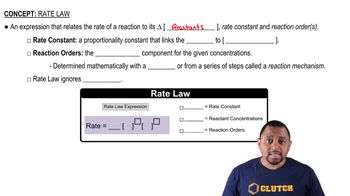
Rate Law

The rate law is an equation that relates the rate of a chemical reaction to the concentration of its reactants. It is typically expressed in the form rate = k[A]^m[B]^n, where k is the rate constant, and m and n are the orders with respect to each reactant. Understanding the rate law is essential for determining how changes in concentration affect the reaction rate.
Video consigliato:
Percorso guidato
01:52
Rate Law Fundamentals

Integrated Rate Laws

Integrated rate laws are mathematical expressions that relate the concentration of reactants to time. They are derived from the differential rate laws and can be used to determine the concentration of reactants at any given time. Different orders of reactions (zero, first, and second) have distinct integrated rate laws, which are crucial for analyzing experimental data and determining the order of a reaction.
Video consigliato:
Percorso guidato
01:52
Rate Law Fundamentals