(a) What factors determine whether a collision between two molecules will lead to a chemical reaction?
Ch.14 - Chemical Kinetics
Brown14th EditionChemistry: The Central ScienceISBN: 9780134414232Non è quello che usi tu?Cambia libro di testo
Capitolo 14, Problema 49a,c
The gas-phase decomposition of NO2, 2 NO2(g) → 2 NO(g) + O2(g), is studied at 383°C, giving the following data:
Time (s) [NO2] (M)
0.0 0.100
5.0 0.017
10.0 0.0090
15.0 0.0062
20.0 0.0047
(a) Is the reaction first order or second order with respect to the concentration of NO2?
(c) Predict the reaction rates at the beginning of the reaction for initial concentrations of 0.200 M, 0.100 M, and 0.050 M NO2.
Guida verificata passo dopo passo1
Identify the rate law for the reaction. Since the reaction is 2 NO_2 \(\rightarrow\) 2 NO + O_2, it is likely a second-order reaction with respect to NO_2.
Use the integrated rate law for a second-order reaction: \( \frac{1}{[A]} = kt + \frac{1}{[A]_0} \), where \([A]\) is the concentration of NO_2 at time \(t\), \([A]_0\) is the initial concentration, and \(k\) is the rate constant.
Calculate the rate constant \(k\) using the given data. Choose two data points, for example, \([NO_2]_0 = 0.100\, M\) at \(t = 0\, s\) and \([NO_2] = 0.017\, M\) at \(t = 5.0\, s\), and substitute into the integrated rate law to solve for \(k\).
Once \(k\) is determined, use the rate law \(rate = k[NO_2]^2\) to calculate the initial reaction rates for the given initial concentrations: 0.200 M, 0.100 M, and 0.050 M.
Substitute each initial concentration into the rate law to find the initial rate for each concentration. Remember, the rate is dependent on the square of the concentration for a second-order reaction.

Risposta video verificata per un problema simile:
Questa soluzione video è stata consigliata dai nostri tutor come utile per risolvere questo problema.
Durata del video:
7mConcetti chiave
Ecco i concetti essenziali che devi comprendere per rispondere correttamente alla domanda.
Reaction Rate
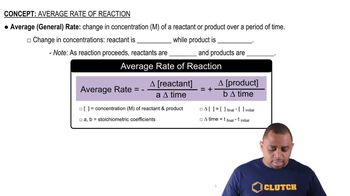
The reaction rate is a measure of how quickly reactants are converted into products in a chemical reaction. It is typically expressed as the change in concentration of a reactant or product per unit time. Understanding how to calculate and interpret reaction rates is essential for predicting the behavior of a reaction under varying conditions.
Video consigliato:
Percorso guidato
Average Rate of Reaction
Rate Law
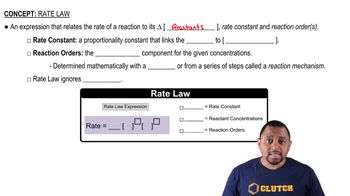
The rate law is an equation that relates the rate of a reaction to the concentration of its reactants, typically in the form Rate = k [A]^m [B]^n, where k is the rate constant, and m and n are the orders of the reaction with respect to reactants A and B. This concept is crucial for predicting how changes in concentration affect the reaction rate.
Video consigliato:
Percorso guidato
Rate Law Fundamentals
Concentration and Its Effect on Reaction Rate
The concentration of reactants plays a significant role in determining the rate of a chemical reaction. Generally, an increase in the concentration of reactants leads to a higher reaction rate due to more frequent collisions between reactant molecules. This principle is fundamental when predicting reaction rates for different initial concentrations.
Video consigliato:
Percorso guidato
Average Rate of Reaction
Pratica correlata
Domanda del libro di testo
607
views
Domanda del libro di testo
Consider the data presented in Exercise 14.19. (a) By using appropriate graphs, determine whether the reaction is first order or second order.
Domanda del libro di testo
Consider the data presented in Exercise 14.19. (c) What is the half-life for the reaction?
724
views
Domanda del libro di testo
Sucrose 1C12H22O112, commonly known as table sugar, reacts in dilute acid solutions to form two simpler sugars, glucose and fructose, both of which have the formula C6H12O6. At 23 C and in 0.5 M HCl, the following data were obtained for the disappearance of sucrose: Time (min) 3C12H22o11 4 1M2 0 0.316 39 0.274 80 0.238 140 0.190 210 0.146 (a) Is the reaction first order or second order with respect to 3C12H22O114?
2567
views