Ch.14 - Chemical Kinetics
Brown - Chemistry: The Central Science 14th Edition
Brown14th EditionChemistry: The Central ScienceISBN: 9780134414232Non è quello che usi tu?Cambia libro di testo
Capitolo 14, Problema 109b

The gas-phase decomposition of ozone is thought to occur by the following two-step mechanism.
Step 1: O3(g) ⇌ O2(g) + O(g) (fast)
Step 2: O(g) + O3(g) → 2 O2 (slow)
(b) Derive the rate law that is consistent with this mechanism. (Hint: The product appears in the rate law.)

Guida verificata passo dopo passo
1
Step 1: Identify the slow step in the reaction mechanism. The rate of the overall reaction is determined by the slowest step, also known as the rate-determining step. In this case, the slow step is: O(g) + O3(g) → 2 O2(g).
Step 2: Write the rate law for the slow step. The rate law for a reaction is the rate equals the rate constant times the concentration of the reactants each raised to a power equal to their stoichiometric coefficients. For this step, the rate law would be: rate = k[O][O3].
Step 3: Consider the fast equilibrium step. In this case, the fast step is: O3(g) ⇌ O2(g) + O(g). This step reaches equilibrium quickly, so we can write an equilibrium expression for it: [O2][O]/[O3] = K, where K is the equilibrium constant.
Step 4: Substitute the concentration of the intermediate. The intermediate is a species that is produced in one step and consumed in another. In this case, O(g) is the intermediate. We can express its concentration in terms of the other species using the equilibrium expression: [O] = K[O3]/[O2].
Step 5: Substitute the expression for [O] into the rate law. This gives us the rate law consistent with the mechanism: rate = k[K[O3]/[O2]][O3] = kK[O3]^2/[O2]. This is the rate law for the reaction.

Risposta video verificata per un problema simile:

Questa soluzione video è stata consigliata dai nostri tutor come utile per risolvere questo problema.
Durata del video:
8m

Concetti chiave

Ecco i concetti essenziali che devi comprendere per rispondere correttamente alla domanda.

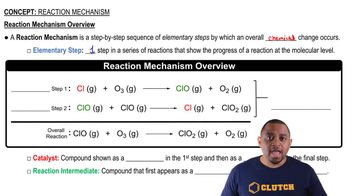
Reaction Mechanism

A reaction mechanism is a step-by-step description of the pathway by which reactants are converted into products. It outlines individual elementary steps, which can be fast or slow, and helps in understanding how the overall reaction occurs. In this case, the mechanism consists of two steps, with the first being fast and the second slow, influencing the rate law derived from the overall process.
Video consigliato:
Percorso guidato
03:06
Reaction Mechanism Overview

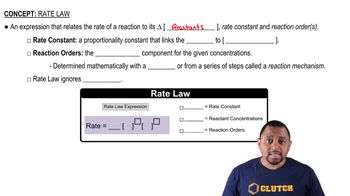
Rate Law

The rate law expresses the relationship between the rate of a chemical reaction and the concentration of its reactants. It is typically formulated based on the slowest step in a multi-step mechanism, as this step dictates the overall reaction rate. The rate law can include products if they are involved in the rate-determining step, as indicated in the hint provided in the question.
Video consigliato:
Percorso guidato
01:52
Rate Law Fundamentals

Elementary Steps

Elementary steps are individual reactions that occur in a reaction mechanism, each with its own rate constant. The rate of an elementary step is directly proportional to the concentrations of the reactants involved, raised to the power of their stoichiometric coefficients. Understanding these steps is crucial for deriving the overall rate law, as the slow step often determines the rate law's form and the concentrations of products may also play a role.
Video consigliato:
Percorso guidato
03:06
Reaction Mechanism Overview
Pratica correlata
Domanda del libro di testo

Ozone in the upper atmosphere can be destroyed by the following two-step mechanism:

Cl(g) + O3(g) → ClO(g) + O2(g)

ClO(g) + O(g) → Cl(g) + O2(g) 

(b) What is the catalyst in the reaction?

621
views

Domanda del libro di testo

Ozone in the upper atmosphere can be destroyed by the following two-step mechanism:

Cl(g) + O3(g) → ClO(g) + O2(g)

ClO(g) + O(g) → Cl(g) + O2(g)

(a) What is the overall equation for this process?

Domanda del libro di testo

The following mechanism has been proposed for the gasphase reaction of chloroform 1CHCl32 and chlorine:

Step 1: Cl2(g) k1⇌ k-1 2 Cl(g) (fast)

Step 2: Cl(g) + CHCl3(g) k2→ HCl(g) + CCl3(g) (slow)

Step 3: Cl(g0 + CCl3(g) k3→ CCl4 (fast)

(e) What is the rate law predicted by this mechanism? (Hint: The overall reaction order is not an integer.)

Domanda del libro di testo
The following mechanism has been proposed for the gasphase reaction of chloroform 1CHCl32 and chlorine: Step 1: Cl21g2 Δ k1 k - 1 2 Cl1g2 1fast2 Step 2: Cl1g2 + CHCl31g2 ¡k2 HCl1g2 + CCl31g2 1slow2 Step 3: Cl1g2 + CCl31g2 ¡k3 CCl4 1fast2 (a) What is the overall reaction?
575
views
Domanda del libro di testo

The gas-phase decomposition of ozone is thought to occur by the following two-step mechanism.

Step 1: O3(g) ⇌ O2(g) + O(g) (fast)

Step 2: O(g) + O3(g) → 2 O2 (slow)

(a) Write the balanced equation for the overall reaction.

Domanda del libro di testo

The gas-phase decomposition of ozone is thought to occur by the following two-step mechanism.

Step 1: O3(g) ⇌ O2(g) + O(g) (fast)

Step 2: O(g) + O3(g) → 2 O2 (slow)

(d) If instead the reaction occurred in a single step, would the rate law change? If so, what would it be?

1055
views