

Ch.14 - Chemical Kinetics
Brown - Chemistry: The Central Science 14th Edition
Brown14th EditionChemistry: The Central ScienceISBN: 9780134414232Non è quello che usi tu?Cambia libro di testo
Capitolo 14, Problema 118c

The reaction between ethyl iodide and hydroxide ion in ethanol (C2H5OH) solution, C2H5I(alc) + OH-(alc) → C2H5OH(l) + I-(alc), has an activation energy of 86.8 kJ/mol and a frequency factor of 2.10 × 10¹¹ M-1 s-1. (c) Which reagent in the reaction is limiting, assuming the reaction proceeds to completion?

Guida verificata passo dopo passo
1
Step 1: The limiting reagent in a chemical reaction is the reactant that is completely consumed first and determines when the reaction stops. In order to determine the limiting reagent, we need to know the initial amounts of the reactants.
Step 2: However, in this problem, no information is given about the initial amounts of the reactants (ethyl iodide and hydroxide ion). Therefore, we cannot determine which reagent is limiting based on the information provided.
Step 3: If the initial amounts of the reactants were provided, you would compare the number of moles of each reactant. This is done by dividing the initial amount of each reactant by its stoichiometric coefficient in the balanced chemical equation.
Step 4: The reactant that has the smallest value from this calculation is the limiting reagent, as it will be consumed first during the reaction.
Step 5: Remember, the limiting reagent determines the maximum amount of product that can be formed. Once the limiting reagent is used up, the reaction cannot proceed any further.

Risposta video verificata per un problema simile:

Questa soluzione video è stata consigliata dai nostri tutor come utile per risolvere questo problema.
Durata del video:
5m

Concetti chiave

Ecco i concetti essenziali che devi comprendere per rispondere correttamente alla domanda.

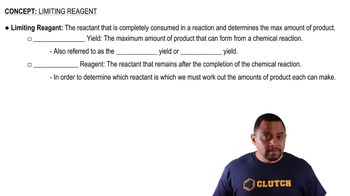
Limiting Reagent

The limiting reagent in a chemical reaction is the reactant that is completely consumed first, thus determining the maximum amount of product that can be formed. To identify the limiting reagent, one must compare the mole ratios of the reactants based on the balanced chemical equation and the initial amounts of each reactant present.
Video consigliato:
Percorso guidato
01:30
Limiting Reagent Concept

Stoichiometry

Stoichiometry is the calculation of reactants and products in chemical reactions based on the conservation of mass. It involves using the coefficients from a balanced chemical equation to determine the relationships between the quantities of reactants and products, allowing for the prediction of how much of each substance will be consumed or produced.
Video consigliato:
Percorso guidato
01:16
Stoichiometry Concept

Activation Energy

Activation energy is the minimum energy required for a chemical reaction to occur. It represents the energy barrier that must be overcome for reactants to transform into products. While it does not directly affect which reagent is limiting, understanding activation energy can provide insight into the reaction's rate and feasibility.
Video consigliato:
Percorso guidato
02:02
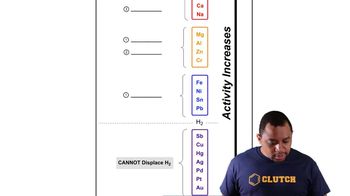
Activity Series Chart
Pratica correlata
Domanda del libro di testo

The reaction between ethyl iodide and hydroxide ion in ethanol (C2H5OH) solution, C2H5I(alc) + OH-(alc) → C2H5OH(l) + I-(alc), has an activation energy of 86.8 kJ/mol and a frequency factor of 2.10 × 10¹¹ M-1 s-1. (d) Assuming the frequency factor and activation energy do not change as a function of temperature, calculate the rate constant for the reaction at 50 C.

532
views
Domanda del libro di testo

The gas-phase reaction of NO with F2 to form NOF and F has an activation energy of Ea = 6.3 kJ>mol. and a frequency factor of A = 6.0 * 108 M-1 s-1. The reaction is believed to be bimolecular: NO1g2 + F21g2 ¡ NOF1g2 + F1g2 (e) Suggest a reason for the low activation energy for the reaction.

793
views
Domanda del libro di testo

Enzymes are often described as following the two-step mechanism:

E + S  ⇌ ES (fast)

ES → E + P (slow)

where E = enzyme, S = substrate, ES = enzyme9substrate complex, and P = product.

(b) Molecules that can bind to the active site of an enzyme but are not converted into product are called enzyme inhibitors. Write an additional elementary step to add into the preceding mechanism to account for the reaction of E with I, an inhibitor.

1129
views
1
rank
Domanda del libro di testo

The gas-phase reaction of NO with F2 to form NOF and F has an activation energy of Ea = 6.3 kJ/mol. and a frequency factor of A = 6.0 × 10⁸ M-1 s-1. The reaction is believed to be bimolecular: NO(g) + F2(g) → NOF(g) + F(g) (b) Draw the Lewis structures for the NO and the NOF molecules, given that the chemical formula for NOF is misleading because the nitrogen atom is actually the central atom in the molecule.