The temperature dependence of the rate constant for a reaction is tabulated as follows: Temperature (K) k 1M 1 s1 2 600 0.028 650 0.22 700 1.3 750 6.0 800 23 Calculate Ea and A.
Guida verificata passo dopo passo
1
Identify the Arrhenius equation: \(k = A e^{-\frac{E_a}{RT}}\), where \(k\) is the rate constant, \(A\) is the pre-exponential factor, \(E_a\) is the activation energy, \(R\) is the gas constant (8.314 J/mol·K), and \(T\) is the temperature in Kelvin.
Take the natural logarithm of both sides of the Arrhenius equation to linearize it: \(\ln k = \ln A - \frac{E_a}{R} \cdot \frac{1}{T}\).
Plot \(\ln k\) versus \(\frac{1}{T}\) using the given data points. The slope of the line will be \(-\frac{E_a}{R}\), and the y-intercept will be \(\ln A\).
Calculate the slope of the line from the plot, which is \(-\frac{E_a}{R}\). Use this slope to solve for \(E_a\) by rearranging the equation: \(E_a = -\text{slope} \times R\).
Determine the y-intercept from the plot, which is \(\ln A\). Solve for \(A\) by taking the exponential of the y-intercept: \(A = e^{\text{y-intercept}}\).
Risposta video verificata per un problema simile:
Questa soluzione video è stata consigliata dai nostri tutor come utile per risolvere questo problema.
Durata del video:
5m
Guarda un video:
1 Commento
Concetti chiave
Ecco i concetti essenziali che devi comprendere per rispondere correttamente alla domanda.
Arrhenius Equation
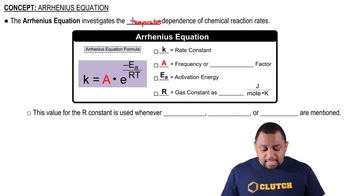
The Arrhenius equation relates the rate constant (k) of a chemical reaction to the temperature (T) and activation energy (Ea). It is expressed as k = A * e^(-Ea/(RT)), where A is the pre-exponential factor, R is the universal gas constant, and T is the temperature in Kelvin. This equation highlights how temperature influences reaction rates and is fundamental for calculating Ea and A.
Activation energy (Ea) is the minimum energy required for a chemical reaction to occur. It represents the energy barrier that reactants must overcome to form products. A higher Ea indicates a slower reaction rate at a given temperature, while a lower Ea suggests a faster reaction. Understanding Ea is crucial for predicting how temperature changes affect reaction rates.
The pre-exponential factor (A) in the Arrhenius equation is a constant that represents the frequency of collisions and the orientation of reactants during a reaction. It reflects the likelihood that collisions will lead to a successful reaction. A is temperature-dependent and can be determined alongside Ea when analyzing the temperature dependence of rate constants.


 Guida verificata passo dopo passo
 01:20
01:20