The accompanying graph shows plots of ln k versus 1>T for two different reactions. The plots have been extrapolated to the y-intercepts. Which reaction (red or blue) has (b) the larger value for the frequency factor, A? [Section 14.5]
Ch.14 - Chemical Kinetics
Brown14th EditionChemistry: The Central ScienceISBN: 9780134414232Non è quello che usi tu?Cambia libro di testo
Capitolo 14, Problema 8a
Which of the following linear plots do you expect for a reaction A¡products if the kinetics are (a) zero order, [Section 14.4]
![Four graphs showing plots of 1/[X], ln[X], and [X] over time for different reaction orders.](https://lightcat-files.s3.amazonaws.com/problem_images/fe3831e00d552752-1666282854514.jpg)
Guida verificata passo dopo passo1
Identify the order of the reaction. For a zero-order reaction, the rate of reaction is independent of the concentration of the reactant.
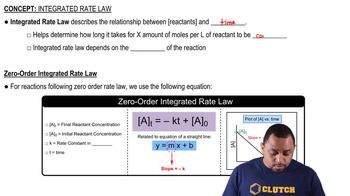
Recall that for a zero-order reaction, the concentration of the reactant [A] decreases linearly over time.
Understand that the integrated rate law for a zero-order reaction is [A] = [A]_0 - kt, where [A]_0 is the initial concentration and k is the rate constant.
Recognize that a plot of [A] versus time will yield a straight line with a negative slope for a zero-order reaction.
Compare the given plots: Plot D shows [X] (which can be considered as [A]) versus time as a straight line, indicating a zero-order reaction.

Risposta video verificata per un problema simile:
Questa soluzione video è stata consigliata dai nostri tutor come utile per risolvere questo problema.
Durata del video:
1mConcetti chiave
Ecco i concetti essenziali che devi comprendere per rispondere correttamente alla domanda.
Zero-Order Kinetics
In zero-order kinetics, the rate of reaction is constant and independent of the concentration of the reactant. This means that the reaction proceeds at a steady rate until the reactant is depleted. The concentration of the reactant decreases linearly over time, leading to a plot of [A] versus time that is a straight line.
Video consigliato:
Percorso guidato
Zero-Order Reactions
Integrated Rate Laws
Integrated rate laws relate the concentration of reactants to time for different orders of reactions. For zero-order reactions, the integrated rate law is [A] = [A]₀ - kt, where [A]₀ is the initial concentration, k is the rate constant, and t is time. This equation indicates that a plot of [A] versus time will yield a straight line, confirming zero-order behavior.
Video consigliato:
Percorso guidato
Rate Law Fundamentals
Graphical Representation of Reaction Orders
Different reaction orders produce distinct graphical representations when plotting concentration versus time or its transformations. For zero-order reactions, a plot of [A] versus time is linear, while plots of 1/[A] or ln[A] versus time are not linear. Understanding these graphical representations is crucial for identifying the order of a reaction based on experimental data.
Video consigliato:
Percorso guidato
Zero-Order Reactions
Pratica correlata
Domanda del libro di testo
780
views
Domanda del libro di testo
The following diagrams represent mixtures of NO(g) and O21g2. These two substances react as follows: 2 NO1g2 + O21g2¡2 NO21g2 It has been determined experimentally that the rate is second order in NO and first order in O2. Based on this fact, which of the following mixtures will have the fastest initial rate? [Section 14.3]
748
views
Domanda del libro di testo
Given the following diagrams at t = 0 min and t = 30 min
After four half-life periods for a first-order reaction, what fraction of reactant remains? [Section 14.4]
997
views
1
rank
1
comments
Domanda del libro di testo
The accompanying graph shows plots of ln k versus 1>T for two different reactions. The plots have been extrapolated to the y-intercepts. Which reaction (red or blue) has (a) the larger value for Ea,
706
views