Ch.15 - Chemical Equilibrium
Brown - Chemistry: The Central Science 14th Edition
Brown14th EditionChemistry: The Central ScienceISBN: 9780134414232Non è quello che usi tu?Cambia libro di testo
Capitolo 15, Problema 38

A flask is charged with 1.500 atm of N2O4 and 1.00 atm NO2 at 25 _x001F_C, and the following equilibrium is achieved: N2O4(g) ⇌ 2 NO2(g). After equilibrium is reached, the partial pressure of NO2 is 0.512 atm. (b) Calculate the value of Kp for the reaction. (c) Calculate Kc for the reaction.

Guida verificata passo dopo passo
1
Identify the initial conditions and changes in the system: Initially, the partial pressures are 1.500 atm for N2O4 and 1.00 atm for NO2. At equilibrium, the partial pressure of NO2 is 0.512 atm.
Determine the change in pressure for NO2: Since the initial pressure of NO2 is 1.00 atm and it decreases to 0.512 atm at equilibrium, the change in pressure for NO2 is 1.00 atm - 0.512 atm.
Use the stoichiometry of the reaction to find the change in pressure for N2O4: Since the reaction is N2O4(g) ⇌ 2 NO2(g), the change in pressure for N2O4 is half of the change in pressure for NO2.
Calculate the equilibrium pressure of N2O4: Subtract the change in pressure from the initial pressure of N2O4 to find its equilibrium pressure.
Calculate Kp using the equilibrium pressures: Use the expression Kp = (P_NO2^2) / (P_N2O4) where P_NO2 and P_N2O4 are the equilibrium partial pressures of NO2 and N2O4, respectively.

Concetti chiave

Ecco i concetti essenziali che devi comprendere per rispondere correttamente alla domanda.

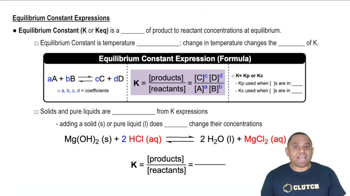
Equilibrium Constant (Kp)

The equilibrium constant Kp is a measure of the ratio of the partial pressures of the products to the reactants at equilibrium for a gas-phase reaction. It is expressed in terms of the partial pressures raised to the power of their coefficients in the balanced chemical equation. For the reaction N2O4(g) ⇌ 2 NO2(g), Kp can be calculated using the formula Kp = (P_NO2^2) / (P_N2O4), where P represents the partial pressures of the gases involved.
Video consigliato:
Percorso guidato
03:20
Equilibrium Constant Expressions

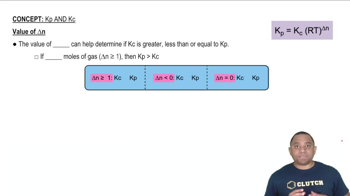
Relationship between Kp and Kc

Kp and Kc are related equilibrium constants for gas-phase reactions, where Kp is based on partial pressures and Kc is based on concentrations. The relationship is given by the equation Kp = Kc(RT)^(Δn), where R is the ideal gas constant, T is the temperature in Kelvin, and Δn is the change in moles of gas (moles of products minus moles of reactants). This relationship allows for the conversion between the two constants depending on the information available.
Video consigliato:
Percorso guidato
02:18
Kp vs Kc Relationship

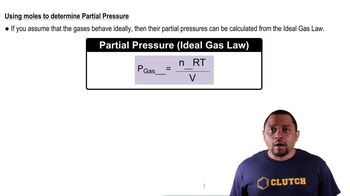
Partial Pressure

Partial pressure is the pressure exerted by a single component of a gas mixture. It is a crucial concept in understanding gas behavior and equilibrium, as it allows for the calculation of equilibrium constants. In the context of the given reaction, the partial pressures of N2O4 and NO2 at equilibrium are used to determine Kp, reflecting how the concentrations of each gas influence the overall equilibrium state.
Video consigliato:
Percorso guidato
00:48
Partial Pressure Calculation