
At 900 K, the following reaction has 𝐾𝑝 = 0.345: 2 SO2(𝑔) + O2(𝑔) ⇌ 2 SO3(𝑔) In an equilibrium mixture the partial pressures of SO2 and O2 are 0.135 atm and 0.455 atm, respectively. What is the equilibrium partial pressure of SO3 in the mixture?
Ch.15 - Chemical Equilibrium
Brown14th EditionChemistry: The Central ScienceISBN: 9780134414232Non è quello che usi tu?Cambia libro di testo
Capitolo 15, Problema 45
At 100 _x001F_C, Kc = 0.078 for the reaction SO2Cl2(g) ⇌ SO2(g) + Cl2(g). In an equilibrium mixture of the three gases, the concentrations of SO2Cl2 and SO2 are 0.108 M and 0.052 M, respectively. What is the partial pressure of Cl2 in the equilibrium mixture?
Guida verificata passo dopo passo1
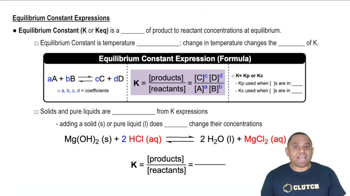
Identify the equilibrium expression for the reaction: SO2Cl2(g) ⇌ SO2(g) + Cl2(g). The equilibrium constant expression (Kc) is given by Kc = [SO2][Cl2]/[SO2Cl2].
Substitute the known values into the equilibrium expression. You have [SO2Cl2] = 0.108 M and [SO2] = 0.052 M. The equilibrium constant Kc is 0.078.
Rearrange the equilibrium expression to solve for the unknown concentration of Cl2. This gives [Cl2] = Kc * [SO2Cl2] / [SO2].
Substitute the known values into the rearranged equation to find the concentration of Cl2. This involves multiplying Kc by [SO2Cl2] and then dividing by [SO2].
The concentration of Cl2 obtained from the calculation is the same as its partial pressure in the equilibrium mixture, assuming ideal gas behavior.
Concetti chiave
Ecco i concetti essenziali che devi comprendere per rispondere correttamente alla domanda.
Equilibrium Constant (Kc)
The equilibrium constant (Kc) is a numerical value that expresses the ratio of the concentrations of products to reactants at equilibrium for a given reaction at a specific temperature. For the reaction SO2Cl2(g) ⇌ SO2(g) + Cl2(g), Kc = [SO2][Cl2]/[SO2Cl2]. A Kc value less than 1 indicates that at equilibrium, the concentration of reactants is greater than that of products.
Video consigliato:
Percorso guidato
Equilibrium Constant Expressions
Partial Pressure
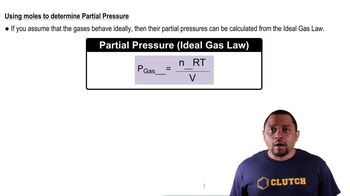
Partial pressure is the pressure exerted by a single component of a gas mixture. According to Dalton's Law, the total pressure of a gas mixture is the sum of the partial pressures of each individual gas. The partial pressure of a gas can be calculated using the ideal gas law, where P = (n/V)RT, or by using the concentration of the gas in the mixture and the total pressure.
Video consigliato:
Percorso guidato
Partial Pressure Calculation
Ideal Gas Law
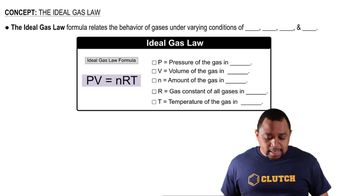
The ideal gas law is a fundamental equation in chemistry that relates the pressure, volume, temperature, and number of moles of an ideal gas. It is expressed as PV = nRT, where P is pressure, V is volume, n is the number of moles, R is the ideal gas constant, and T is temperature in Kelvin. This law allows for the calculation of gas properties under various conditions, including determining partial pressures in equilibrium systems.
Video consigliato:
Percorso guidato
Ideal Gas Law Formula
Pratica correlata
Domanda del libro di testo
1046
views
Domanda del libro di testo
At 100°C, the equilibrium constant for the reaction COCl2(𝑔) ⇌ CO(𝑔) + Cl2(𝑔) has the value 𝐾𝑐 = 2.19×10⁻¹⁰. Are the following mixtures of COCl2, CO, and Cl2 at 100°C at equilibrium? If not, indicate the direction that the reaction must proceed to achieve equilibrium.
(a) [COCl2] = 2.00×10⁻³ M, [CO] = 3.3×10⁻⁶ M, [Cl2] = 6.62×10⁻⁶ M
(b) [COCl2] = 4.50×10⁻² M, [CO] = 1.1×10⁻⁷ M, [Cl2] = 2.25×10⁻⁶ M
(c) [COCl2] = 0.0100 M, [CO] = [Cl2] = 1.48×10⁻⁶ M
736
views
Domanda del libro di testo
(b) At the start of a certain reaction, only reactants are present; no products have been formed. What is the value of Qc at this point in the reaction?
596
views
