
Ch.15 - Chemical Equilibrium
Brown - Chemistry: The Central Science 14th Edition
Brown14th EditionChemistry: The Central ScienceISBN: 9780134414232Non è quello che usi tu?Cambia libro di testo
Capitolo 15, Problema 84

At 900 °C, 𝐾𝑐 = 0.0108 for the reaction
CaCO3(𝑠) ⇌ CaO(𝑠) + CO2(𝑔)
A mixture of CaCO3, CaO, and CO2 is placed in a 10.0-L vessel at 900°C. For the following mixtures, will the amount of CaCO3 increase, decrease, or remain the same as the system approaches equilibrium?
(a) 15.0 g CaCO3, 15.0 g CaO, and 4.25 g CO2
(b) 2.50 g CaCO3, 25.0 g CaO, and 5.66 g CO2
(c) 30.5 g CaCO3, 25.5 g CaO, and 6.48 g CO2

Guida verificata passo dopo passo
1
Calculate the initial concentration of CO_2 using its mass and the volume of the vessel. Use the formula: \( \text{Concentration} = \frac{\text{mass}}{\text{molar mass} \times \text{volume}} \).
Determine the reaction quotient, \( Q_c \), using the initial concentration of CO_2. Since CaCO_3 and CaO are solids, they do not appear in the expression for \( Q_c \). Thus, \( Q_c = [\text{CO}_2] \).
Compare \( Q_c \) to the equilibrium constant \( K_c \). If \( Q_c < K_c \), the reaction will proceed to the right, increasing the amount of CO_2 and decreasing CaCO_3. If \( Q_c > K_c \), the reaction will proceed to the left, decreasing the amount of CO_2 and increasing CaCO_3.
Use the comparison from the previous step to determine if the amount of CaCO_3 will increase, decrease, or remain the same as the system approaches equilibrium.
Conclude based on the direction of the shift in equilibrium whether the amount of CaCO_3 will increase, decrease, or remain the same.

Risposta video verificata per un problema simile:

Questa soluzione video è stata consigliata dai nostri tutor come utile per risolvere questo problema.
Durata del video:
5m

Concetti chiave

Ecco i concetti essenziali che devi comprendere per rispondere correttamente alla domanda.

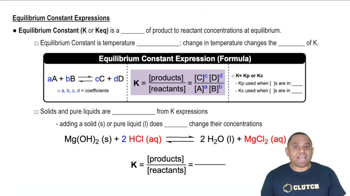
Equilibrium Constant (Kc)

The equilibrium constant, Kc, quantifies the ratio of the concentrations of products to reactants at equilibrium for a given reaction at a specific temperature. For the reaction CaCO3(s) ⇌ CaO(s) + CO2(g), Kc = [CO2] / [CaCO3]. A Kc value less than 1 indicates that at equilibrium, the reactants are favored, while a value greater than 1 suggests that products are favored.
Video consigliato:
Percorso guidato
03:20
Equilibrium Constant Expressions

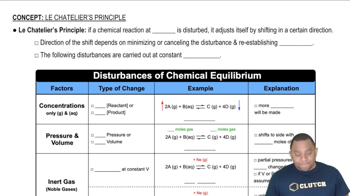
Le Chatelier's Principle

Le Chatelier's Principle states that if a dynamic equilibrium is disturbed by changing the conditions, the system will adjust to counteract the change and restore a new equilibrium. In this context, adding or removing reactants or products, or changing temperature or pressure, will shift the position of equilibrium, affecting the amounts of CaCO3, CaO, and CO2.
Video consigliato:
Percorso guidato
07:32
Le Chatelier's Principle

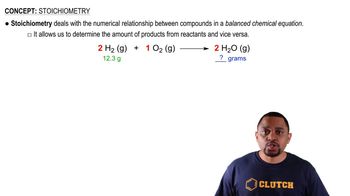
Stoichiometry of the Reaction

Stoichiometry involves the quantitative relationships between the amounts of reactants and products in a chemical reaction. For the reaction CaCO3(s) ⇌ CaO(s) + CO2(g), the stoichiometric coefficients indicate that one mole of CaCO3 produces one mole of CaO and one mole of CO2. Understanding these relationships is crucial for predicting how changes in the amounts of substances will affect the equilibrium state.
Video consigliato:
Percorso guidato
01:16
Stoichiometry Concept