
A sample of nitrosyl bromide (NOBr) decomposes according to the equation 2 NOBr(𝑔) ⇌ 2 NO(𝑔) + Br2(𝑔) An equilibrium mixture in a 5.00-L vessel at 100°C contains 3.22 g of NOBr, 3.08 g of NO, and 4.19 g of Br2. (b) What is the total pressure exerted by the mixture of gases?
Ch.15 - Chemical Equilibrium
Brown14th EditionChemistry: The Central ScienceISBN: 9780134414232Non è quello che usi tu?Cambia libro di testo
Capitolo 15, Problema 77
Consider the hypothetical reaction A1g2 Δ 2 B1g2. A flask is charged with 0.75 atm of pure A, after which it is allowed to reach equilibrium at 0 _x001F_C. At equilibrium, the partial pressure of A is 0.36 atm. (a) What is the total pressure in the flask at equilibrium?
Guida verificata passo dopo passo1
Start by writing the balanced chemical equation for the reaction: \( A(g) \rightarrow 2B(g) \). This indicates that one mole of A produces two moles of B.
Determine the change in pressure for A. Initially, the pressure of A is 0.75 atm, and at equilibrium, it is 0.36 atm. The change in pressure for A is \( 0.75 - 0.36 = 0.39 \) atm.
Use the stoichiometry of the reaction to find the change in pressure for B. Since 1 mole of A produces 2 moles of B, the change in pressure for B is \( 2 \times 0.39 = 0.78 \) atm.
Calculate the equilibrium pressure of B. Since B is formed from A, its equilibrium pressure is simply the change in pressure, which is 0.78 atm.
Add the equilibrium pressures of A and B to find the total pressure in the flask at equilibrium: \( 0.36 \text{ atm (A)} + 0.78 \text{ atm (B)} = 1.14 \text{ atm} \).
Concetti chiave
Ecco i concetti essenziali che devi comprendere per rispondere correttamente alla domanda.
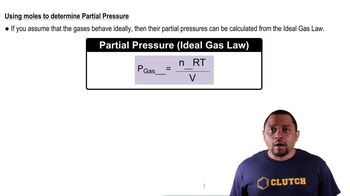
Partial Pressure
Partial pressure is the pressure exerted by a single component of a gas mixture. In a system at equilibrium, the total pressure is the sum of the partial pressures of all gases present. Understanding how to calculate partial pressures is essential for determining the total pressure in a reaction involving gases.
Video consigliato:
Percorso guidato
Partial Pressure Calculation
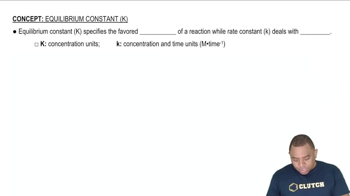
Equilibrium Constant
The equilibrium constant (K) is a value that expresses the ratio of the concentrations of products to reactants at equilibrium for a given reaction at a specific temperature. It helps predict the direction of the reaction and the concentrations of species at equilibrium. In this case, knowing the equilibrium constant can aid in understanding how the pressures of A and B relate to each other.
Video consigliato:
Percorso guidato
Equilibrium Constant K
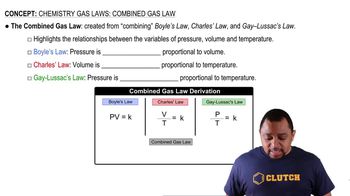
Gas Laws
Gas laws describe the behavior of gases in relation to pressure, volume, and temperature. The ideal gas law (PV=nRT) is particularly relevant here, as it relates the total pressure, volume, and temperature of a gas mixture. Understanding these laws is crucial for calculating the total pressure in the flask after the reaction reaches equilibrium.
Video consigliato:
Percorso guidato
Combined Gas Law
Pratica correlata
Domanda del libro di testo
1082
views
Domanda del libro di testo
Consider the hypothetical reaction A(g) ⇌ 2 B(g). A flask is charged with 0.75 atm of pure A, after which it is allowed to reach equilibrium at 0°C. At equilibrium, the partial pressure of A is 0.36 atm. (c) What could we do to maximize the yield of B?
476
views
Domanda del libro di testo
A sample of nitrosyl bromide (NOBr) decomposes according to the equation 2 NOBr(g) ⇌ 2 NO(g) + Br2(g) An equilibrium mixture in a 5.00-L vessel at 100°C contains 3.22 g of NOBr, 3.08 g of NO, and 4.19 g of Br2. (c) What was the mass of the original sample of NOBr?
1100
views
