
At 80°C, 𝐾𝑐 = 1.87×10⁻³ for the reaction PH3BCl3(𝑠) ⇌ PH3(𝑔) + BCl3(𝑔) (a) Calculate the equilibrium concentrations of PH3 and BCl3 if a solid sample of PH3BCl3 is placed in a closed vessel at 80°C and decomposes until equilibrium is reached.
Ch.15 - Chemical Equilibrium
Brown14th EditionChemistry: The Central ScienceISBN: 9780134414232Non è quello che usi tu?Cambia libro di testo
Capitolo 15, Problema 57
For the reaction I2(g) + Br2(g) ⇌ 2 IBr(g), Kc = 280 at 150 _x001F_C. Suppose that 0.500 mol IBr in a 2.00-L flask is allowed to reach equilibrium at 150 _x001F_C. What are the equilibrium concentrations of IBr, I2, and Br2?
Guida verificata passo dopo passo1
Step 1: Write the balanced chemical equation for the reaction: I2(g) + Br2(g) ⇌ 2 IBr(g).
Step 2: Define the initial concentrations of the reactants and products. Since 0.500 mol of IBr is placed in a 2.00 L flask, the initial concentration of IBr is 0.500 mol / 2.00 L = 0.250 M. The initial concentrations of I2 and Br2 are both 0 M.
Step 3: Set up an ICE (Initial, Change, Equilibrium) table to track the changes in concentrations. Let x be the change in concentration of I2 and Br2 that reacts to form IBr. The changes in concentration will be: I2: +x, Br2: +x, IBr: -2x.
Step 4: Express the equilibrium concentrations in terms of x: [I2] = x, [Br2] = x, [IBr] = 0.250 - 2x.
Step 5: Use the equilibrium constant expression Kc = [IBr]^2 / ([I2][Br2]) = 280 to solve for x. Substitute the equilibrium concentrations into the expression and solve for x to find the equilibrium concentrations of I2, Br2, and IBr.
Concetti chiave
Ecco i concetti essenziali che devi comprendere per rispondere correttamente alla domanda.
Equilibrium Constant (Kc)
The equilibrium constant (Kc) is a numerical value that expresses the ratio of the concentrations of products to reactants at equilibrium for a given reaction at a specific temperature. For the reaction I2(g) + Br2(g) ⇌ 2 IBr(g), Kc = [IBr]^2 / ([I2][Br2]). A higher Kc value indicates a greater concentration of products at equilibrium.
Video consigliato:
Percorso guidato
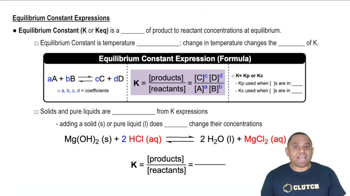
Equilibrium Constant Expressions
Initial Concentration and Changes at Equilibrium
To find the equilibrium concentrations, we start with the initial concentration of IBr and assume that the changes in concentrations of I2 and Br2 are represented by 'x'. The initial concentration of IBr is calculated from the number of moles and volume of the flask, and the changes in concentrations are determined based on the stoichiometry of the reaction.
Video consigliato:
Percorso guidato
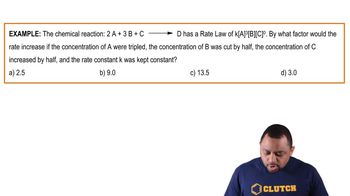
Concentration Changes and Rate Law Example
ICE Table (Initial, Change, Equilibrium)
An ICE table is a tool used to organize the initial concentrations, the changes in concentrations, and the equilibrium concentrations of reactants and products in a chemical reaction. By filling out the ICE table with the initial amounts, the changes (based on the stoichiometry), and solving for equilibrium concentrations, one can systematically determine the concentrations at equilibrium.
Video consigliato:
Percorso guidato
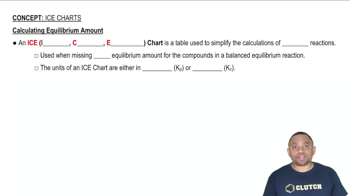
ICE Charts and Equilibrium Amount
Pratica correlata
Domanda del libro di testo
496
views
Domanda del libro di testo
At 80°C, 𝐾𝑐 = 1.87×10⁻³ for the reaction PH3BCl3(𝑠) ⇌ PH3(𝑔) + BCl3(𝑔) (a) Calculate the equilibrium concentrations of PH3 and BCl3 if a solid sample of PH3BCl3 is placed in a closed vessel at 80°C and decomposes until equilibrium is reached. (b) If the flask has a volume of 0.250 L, what is the minimum mass of PH3BCl3(𝑠) that must be added to the flask to achieve equilibrium?
302
views
1
rank
Domanda del libro di testo
At 25°C, the reaction CaCrO4(𝑠) ⇌ Ca2+(𝑎𝑞) + CrO42−(𝑎𝑞) has an equilibrium constant 𝐾𝑐 = 7.1×10⁻⁴. What are the equilibrium concentrations of Ca2+ and CrO42− in a saturated solution of CaCrO4?
398
views
Domanda del libro di testo
Consider the following equilibrium, for which Δ𝐻<0
2 SO2(𝑔) + O2(𝑔) ⇌ 2 SO3(𝑔)
(e) the total pressure of the system is increased by adding a noble gas
