Ch.15 - Chemical Equilibrium
Brown - Chemistry: The Central Science 14th Edition
Brown14th EditionChemistry: The Central ScienceISBN: 9780134414232Non è quello che usi tu?Cambia libro di testo
Capitolo 15, Problema 21

If 𝐾𝑐 = 0.042 for PCl3(𝑔) + Cl2(𝑔) ⇌ PCl5(𝑔) at 500 K, what is the value of 𝐾𝑝 for this reaction at this temperature?

Guida verificata passo dopo passo
1
Identify the balanced chemical equation for the reaction: PCl3(g) + Cl2(g) ⇌ PCl5(g).
Note that the reaction involves gases, and the relationship between Kc and Kp is given by the equation Kp = Kc(RT)Δn, where Δn is the change in moles of gas (moles of products - moles of reactants), R is the gas constant, and T is the temperature in Kelvin.
Calculate Δn for the reaction: Δn = moles of PCl5 - (moles of PCl3 + moles of Cl2) = 1 - (1 + 1) = -1.
Substitute the values into the equation for Kp: Kp = Kc(RT)Δn = 0.042(RT)-1. Here, R is typically 0.0821 L·atm/K·mol, and T is given as 500 K.
Calculate Kp using the values of R, T, and Δn to find the effect of the negative exponent on (RT).

Risposta video verificata per un problema simile:

Questa soluzione video è stata consigliata dai nostri tutor come utile per risolvere questo problema.
Durata del video:
2m

Concetti chiave

Ecco i concetti essenziali che devi comprendere per rispondere correttamente alla domanda.

Equilibrium Constants

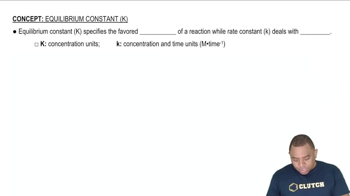
Equilibrium constants, denoted as Kc for concentrations and Kp for partial pressures, quantify the ratio of products to reactants at equilibrium. Kc is used when dealing with molar concentrations, while Kp is applicable for gases and is expressed in terms of their partial pressures. The relationship between Kc and Kp is crucial for converting between these two forms, especially when dealing with gaseous reactions.
Video consigliato:
Percorso guidato
01:14
Equilibrium Constant K

Relationship Between Kc and Kp

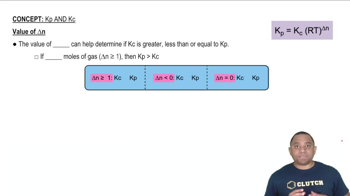
The relationship between Kc and Kp is given by the equation Kp = Kc(RT)^(Δn), where R is the ideal gas constant, T is the temperature in Kelvin, and Δn is the change in moles of gas (moles of products minus moles of reactants). This equation allows for the conversion of Kc to Kp and vice versa, depending on the conditions of the reaction. Understanding this relationship is essential for solving equilibrium problems involving gases.
Video consigliato:
Percorso guidato
02:18
Kp vs Kc Relationship

Change in Moles of Gas (Δn)

Δn represents the difference in the number of moles of gaseous products and reactants in a chemical reaction. It is calculated by subtracting the total moles of reactants from the total moles of products. This value is critical in the Kp and Kc relationship, as it influences the conversion factor (RT)^(Δn) when calculating the equilibrium constant for a reaction involving gases.
Video consigliato:
Percorso guidato
03:42
Reversible Changes in Matter