Ch.15 - Chemical Equilibrium
Brown - Chemistry: The Central Science 14th Edition
Brown14th EditionChemistry: The Central ScienceISBN: 9780134414232Non è quello che usi tu?Cambia libro di testo
Capitolo 15, Problema 14a

The equilibrium constant for the dissociation of molecular iodine, I2(g) ⇌ 2 I(g), at 800 K is Kc = 3.1 × 10⁻⁵. (a) Which species predominates at equilibrium I2 or I?

Guida verificata passo dopo passo
1
Understand the equilibrium expression for the reaction: I2(g) ⇌ 2 I(g). The equilibrium constant, Kc, is given for this reaction.
Write the expression for the equilibrium constant Kc: Kc=[I]2[I2]. This expression relates the concentrations of the products and reactants at equilibrium.
Consider the value of Kc = 3.1 × 10⁻⁵. A small Kc value indicates that the equilibrium position favors the reactants over the products.
Analyze the equilibrium position: Since Kc is much less than 1, the concentration of I2(g) is greater than the concentration of I(g) at equilibrium.
Conclude which species predominates: Given the small value of Kc, I2(g) predominates at equilibrium over I(g).

Risposta video verificata per un problema simile:

Questa soluzione video è stata consigliata dai nostri tutor come utile per risolvere questo problema.
Durata del video:
3m

Concetti chiave

Ecco i concetti essenziali che devi comprendere per rispondere correttamente alla domanda.

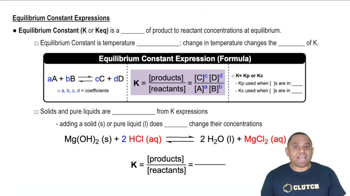
Equilibrium Constant (Kc)

The equilibrium constant, Kc, quantifies the ratio of the concentrations of products to reactants at equilibrium for a given reaction at a specific temperature. For the dissociation of I2, Kc = [I]^2 / [I2]. A small Kc value, like 3.1 × 10^–5, indicates that at equilibrium, the concentration of reactants (I2) is much greater than that of the products (I), suggesting that the reaction favors the formation of reactants.
Video consigliato:
Percorso guidato
03:20
Equilibrium Constant Expressions

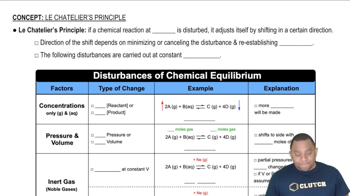
Le Chatelier's Principle

Le Chatelier's Principle states that if a dynamic equilibrium is disturbed by changing the conditions, the system will adjust to counteract the change and restore a new equilibrium. In the context of the dissociation of I2, if the concentration of I is increased or the temperature is altered, the equilibrium will shift to either the right (producing more I) or the left (producing more I2) to minimize the disturbance.
Video consigliato:
Percorso guidato
07:32
Le Chatelier's Principle

Predominance of Species at Equilibrium

To determine which species predominates at equilibrium, one must compare the concentrations of the reactants and products using the equilibrium constant. A Kc value significantly less than 1 indicates that the reactants are favored, meaning that at equilibrium, the concentration of I2 will be much higher than that of I, confirming that I2 predominates in this reaction.
Video consigliato:
Percorso guidato
03:03
Amphoteric Species
Pratica correlata
Domanda del libro di testo

The diagram shown here represents the equilibrium state for the reaction A2(𝑔) + 2B(𝑔) ⇌ 2AB(𝑔). (a) Assuming the volume is 2 L, calculate the equilibrium constant 𝐾𝑐 for the reaction.

663
views

Domanda del libro di testo

The equilibrium constant for the dissociation of molecular iodine, I2(g) ⇌ 2 I(g), at 800 K is Kc = 3.1×10⁻⁵. (b) Assuming both forward and reverse reactions are elementary reactions, which reaction has the larger rate constant, the forward or the reverse reaction?

1209
views
Domanda del libro di testo

Write the expressions for Kc for the following reactions. In each case indicate whether the reaction is homogeneous or heterogeneous.

(a) 2 O3(g) ⇌ 3 O2(g)

(c) 2 C2H4(g) + 2 H2O(g) ⇌ 2 C2H6(g) + O2(g)

(d) C(s) + 2 H2(g) ⇌ CH4(g)

(e) 4 HCl(aq) + O2(g) ⇌ 2 H2O(l) + 2 Cl2(g)

(f) 2 C8H18(l) + 25 O2(g) ⇌ 16 CO2(g) + 18 H2O(g)

(g) 2 C8H18(l) + 25 O2(g) ⇌ 16 CO2(g) + 18 H2O(l)

487
views
Domanda del libro di testo

Write the expression for Kc for the following reactions. In each case indicate whether the reaction is homogeneous or heterogeneous.

(a) 3 NO(g) ⇌ N2O(g) + NO2(g)

(b) CH4(g) + 2 H2S(g) ⇌ CS2(g) + 4 H2(g)

(c) Ni(CO)4(g) ⇌ Ni(s) + 4 CO(g)

(d) HF(aq) ⇌ H+(aq) + F-(aq)  

(e) 2Ag(s) + Zn2+(aq) ⇌ 2 Ag+(aq) + Zn(s)

(f) H2O(l) ⇌ H+(aq) + OH-(aq)

(g) 2 H2O(l) ⇌ 2 H+(aq) + 2 OH-(aq)

574
views
Domanda del libro di testo

Suppose that the gas-phase reactions A → B and B → A are both elementary reactions with rate constants of 4.7×10⁻³ s−1 and 5.8×10⁻¹ s−1, respectively. (a) What is the value of the equilibrium constant for the equilibrium A(g) ⇌ B(g)? (b) Which is greater at equilibrium, the partial pressure of A or the partial pressure of B?

469
views