
Ch.15 - Chemical Equilibrium
Brown - Chemistry: The Central Science 14th Edition
Brown14th EditionChemistry: The Central ScienceISBN: 9780134414232Non è quello che usi tu?Cambia libro di testo
Capitolo 15, Problema 74

When 2.00 mol of SO2Cl2 is placed in a 2.00-L flask at 303 K, 56% of the SO2Cl2 decomposes to SO2 and Cl2: SO2Cl2(g) ⇌ SO2(g) + Cl2(g). Use the equilibrium constant you calculated above to determine the percentage of SO2Cl2 that decomposes when 2.00 mol of SO2Cl2 is placed in a 15.00-L vessel at 303 K.

Guida verificata passo dopo passo
1
Start by understanding the initial conditions: You have 2.00 mol of SO2Cl2 in a 2.00-L flask, and 56% of it decomposes. This means that initially, 1.12 mol of SO2Cl2 decomposes into SO2 and Cl2.
Calculate the equilibrium concentrations for the initial scenario: Since 56% decomposes, you have 0.88 mol of SO2Cl2 remaining. The concentration of SO2Cl2 is \( \frac{0.88 \text{ mol}}{2.00 \text{ L}} \). Similarly, the concentration of SO2 and Cl2 formed is \( \frac{1.12 \text{ mol}}{2.00 \text{ L}} \) each.
Use the equilibrium constant expression for the reaction: \( K_c = \frac{[SO_2][Cl_2]}{[SO_2Cl_2]} \). Substitute the concentrations from the initial scenario to find the equilibrium constant \( K_c \).
Now, consider the new scenario with a 15.00-L vessel. The initial concentration of SO2Cl2 is \( \frac{2.00 \text{ mol}}{15.00 \text{ L}} \). Let 'x' be the amount of SO2Cl2 that decomposes. The equilibrium concentrations will be \( \frac{2.00 - x}{15.00} \) for SO2Cl2 and \( \frac{x}{15.00} \) for both SO2 and Cl2.
Set up the equilibrium expression using the previously calculated \( K_c \) and solve for 'x'. This will give you the amount of SO2Cl2 that decomposes in the 15.00-L vessel. Finally, calculate the percentage decomposed by \( \frac{x}{2.00} \times 100 \).

Concetti chiave

Ecco i concetti essenziali che devi comprendere per rispondere correttamente alla domanda.

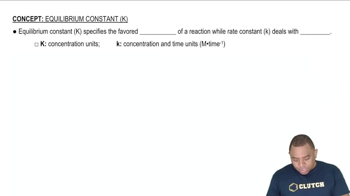
Equilibrium Constant (K)

The equilibrium constant (K) is a numerical value that expresses the ratio of the concentrations of products to reactants at equilibrium for a given reaction at a specific temperature. It provides insight into the extent of a reaction and helps predict the direction in which the reaction will proceed. A larger K value indicates a greater concentration of products at equilibrium, while a smaller K suggests that reactants are favored.
Video consigliato:
Percorso guidato
01:14
Equilibrium Constant K

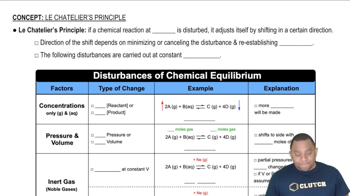
Le Chatelier's Principle

Le Chatelier's Principle states that if a dynamic equilibrium is disturbed by changing the conditions, the system will adjust to counteract the change and restore a new equilibrium. This principle is crucial for understanding how changes in concentration, volume, or temperature affect the position of equilibrium in a chemical reaction, allowing predictions about the behavior of the system under different conditions.
Video consigliato:
Percorso guidato
07:32
Le Chatelier's Principle

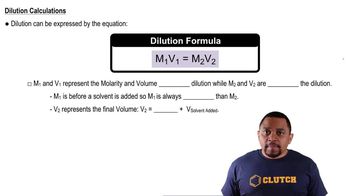
Molarity and Dilution

Molarity is a measure of concentration defined as the number of moles of solute per liter of solution. When a gas is placed in a larger volume, its concentration decreases, which can shift the equilibrium position according to Le Chatelier's Principle. Understanding how to calculate molarity and how dilution affects the concentration of reactants and products is essential for predicting the outcome of reactions in different volumes.
Video consigliato:
Percorso guidato
00:58
Dilution Equation