
Ch.16 - Acid-Base Equilibria
Brown - Chemistry: The Central Science 14th Edition
Brown14th EditionChemistry: The Central ScienceISBN: 9780134414232Non è quello che usi tu?Cambia libro di testo
Capitolo 16, Problema 40c

Addition of phenolphthalein to an unknown colorless solution does not cause a color change. The addition of bromthymol blue to the same solution leads to a yellow color. (c) What other indicator or indicators would you want to use to determine the pH of the solution more precisely?

Guida verificata passo dopo passo
1
Identify the pH range where phenolphthalein changes color, which is approximately 8.2 to 10.0. Since there is no color change, the pH is likely below 8.2.
Identify the pH range where bromthymol blue changes color. It turns yellow in acidic solutions with a pH below 6.0.
Since bromthymol blue turns yellow, the pH of the solution is likely below 6.0.
Consider using an indicator that changes color in the pH range below 6.0 to narrow down the pH more precisely. Methyl orange, which changes from red to yellow between pH 3.1 and 4.4, could be a good choice.
Another option is to use methyl red, which changes from red to yellow between pH 4.4 and 6.2, to further pinpoint the pH range.

Risposta video verificata per un problema simile:

Questa soluzione video è stata consigliata dai nostri tutor come utile per risolvere questo problema.
Durata del video:
2m

Concetti chiave

Ecco i concetti essenziali che devi comprendere per rispondere correttamente alla domanda.

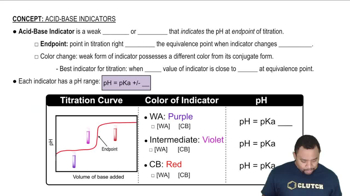
pH Indicators

pH indicators are substances that change color in response to changes in pH levels. They are used to determine the acidity or basicity of a solution. Different indicators have specific pH ranges over which they change color, making them suitable for various applications in titrations and pH testing.
Video consigliato:
Percorso guidato
04:30
Acid-Base Indicators

Acid-Base Chemistry

Acid-base chemistry involves the study of acids, bases, and their reactions. Acids donate protons (H+) in solution, while bases accept protons. The pH scale, ranging from 0 to 14, quantifies the acidity or basicity of a solution, with values below 7 indicating acidity and above 7 indicating basicity.
Video consigliato:
Percorso guidato
02:00
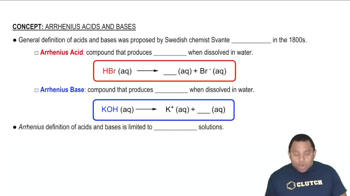
Arrhenius Acids and Bases

Color Change of Indicators

The color change of pH indicators occurs due to structural changes in the indicator molecules when they gain or lose protons. For example, phenolphthalein is colorless in acidic solutions and turns pink in basic solutions, while bromthymol blue is yellow in acidic conditions and blue in basic conditions. Understanding these transitions helps in selecting appropriate indicators for specific pH ranges.
Video consigliato:
Percorso guidato
04:30
Acid-Base Indicators